S&P 500 — US Large Cap Index
 FTSE 100 — UK Blue Chips
 Euro Stoxx 50 — Eurozone Leaders
 DAX 40 — German Equities
 CAC 40 — French Market Index
 Nikkei 225 — Japan Benchmark
 Hang Seng — Hong Kong Index
 Shanghai Composite — China Mainland
 ASX 200 — Australian Market
 TSX Composite — Canada Index
 Nifty 50 — India Large Cap
 STI Index — Singapore Market
 KOSPI — South Korea Index
 Bovespa — Brazil Equities
 JSE Top 40 — South Africa Index
 IPC Index — Mexico Market

U.S. stock index futures are pointing to a weaker open on Friday, with technology stocks leading the decline ahead of the Wall Street session. Nasdaq 100 futures are down around 1.3% , while S&P 500 futures lose 0.5% . Dow Jones futures are only modestly lower , reflecting the index’s smaller exposure to technology and semiconductor companies. The main source of pressure remains the ongoing sell-off in technology stocks, fueled by growing concerns over the rising cost of artificial intelligence infrastructure and shifting expectations for Federal Reserve policy. The heaviest selling is concentrated in the semiconductor sector.
Micron Technology shares are down around 5% in premarket trading , giving back part of the strong gains recorded after its impressive quarterly earnings report. Other chipmakers, including Intel, Arm Holdings, Marvell, and Sandisk , are also trading lower, suggesting investors are taking profits across the sector despite continued robust demand for AI-related hardware.
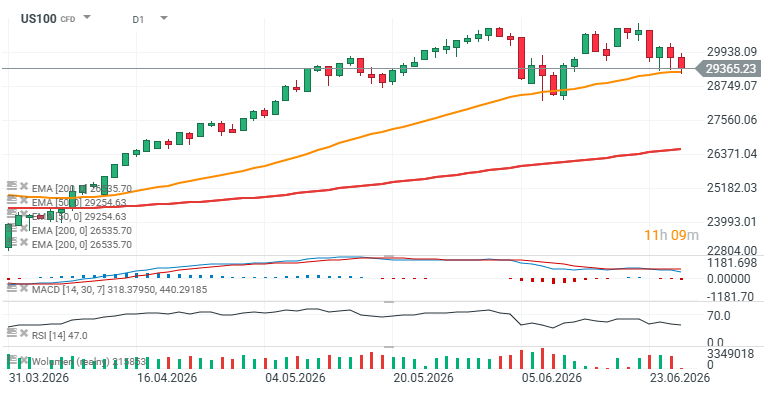
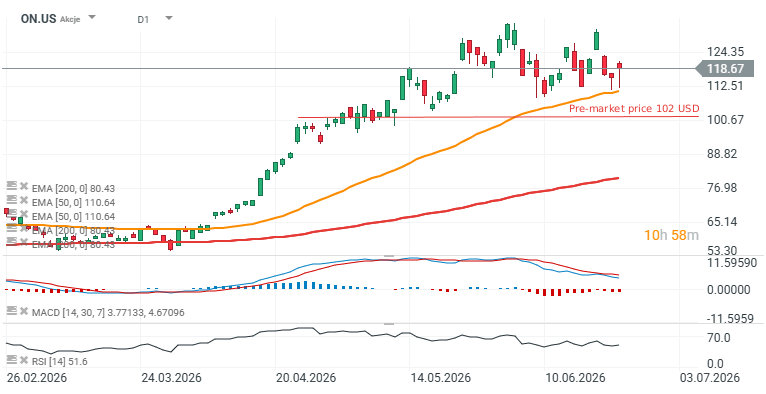
The Technology Select Sector SPDR ETF (XLK) is down approximately 1.6% , while On Semiconductor is among the biggest losers, falling about 13% after announcing its $7 billion acquisition of Synaptics . US100 (D1 Timeframe) Looking at the US100 futures chart, the index has tested its 50-day exponential moving average (EMA50) . If buyers manage to defend this level, a 1:1 corrective pattern could develop, with the next key resistance located around 30,800 points . However, a break below the 29,000-point level would invalidate this bullish scenario and could signal a period of near-term weakness for Wall Street.
Source: xStation5
Rising AI Infrastructure Costs Worry Investors
An increasing number of investors are focusing on the rapidly rising costs associated with artificial intelligence infrastructure. Higher prices for DRAM and NAND memory , essential components for AI data centers, are beginning to affect manufacturers of computers, smartphones, and consumer electronics. The surge in component costs recently prompted Apple to raise prices on selected iPad and MacBook models, while Microsoft announced price increases for its Xbox gaming consoles. Investors are increasingly concerned that similar pricing actions may soon spread across the broader technology sector.
Beyond technology stocks, markets are also closely monitoring the outlook for U.S. monetary policy. Higher-than-expected inflation and changing expectations regarding future Federal Reserve decisions are increasing volatility across equity markets. Higher interest rates typically weigh most heavily on growth stocks, whose valuations depend largely on future cash flows. Market strategists note that the current environment is exceptionally sensitive to both AI-related news and signals from the Federal Reserve. The combination of elevated technology valuations, rising AI infrastructure costs, and uncertainty over interest rates is creating conditions for heightened volatility on Wall Street. The weakness is not limited to the United States.
In Asia, SoftBank plunged more than 12% , while Japan’s Nikkei 225 fell over 4% . Sharp declines were also recorded across South Korea, Hong Kong, and mainland China. European technology stocks are under pressure as well, with ASML, Infineon, STMicroelectronics, and ASM International all opening the session significantly lower.
On Semiconductor shares (D1)
Source: xStation5