S&P 500 — US Large Cap Index
 FTSE 100 — UK Blue Chips
 Euro Stoxx 50 — Eurozone Leaders
 DAX 40 — German Equities
 CAC 40 — French Market Index
 Nikkei 225 — Japan Benchmark
 Hang Seng — Hong Kong Index
 Shanghai Composite — China Mainland
 ASX 200 — Australian Market
 TSX Composite — Canada Index
 Nifty 50 — India Large Cap
 STI Index — Singapore Market
 KOSPI — South Korea Index
 Bovespa — Brazil Equities
 JSE Top 40 — South Africa Index
 IPC Index — Mexico Market
Natural Gas Forecast: Hurricane Risk and Winter Weather Outlook Support Prices

Contributor: Currency Hedger | Market Analysis: Louis Roche, Today Markets
Natural gas prices enter Monday, 12 October, with bullish momentum building on both sides of the Atlantic. US natural gas futures gained approximately 2.5% towards the end of last week, while European prices advanced by more than 4%, as weather uncertainty, potential supply disruptions and geopolitical tensions combined to support the market.
The outlook for the coming sessions will depend on whether these supply-side concerns can outweigh the impact of rising inventories and uncertainty over winter demand. Hurricane-related disruptions in the Gulf of Mexico could tighten near-term US supply, while conflicting seasonal forecasts from major weather models are making it more difficult for traders to assess the likely balance between consumption and production.
At the same time, the latest US Energy Information Administration (EIA) storage report showed a larger inventory build than the market had anticipated. This remains an important counterweight to the bullish narrative, particularly if production recovers quickly and temperatures remain relatively mild.
For Monday, the key question is whether last week’s advance marks the beginning of a sustained recovery or another move within the broader trading range.
Market Snapshot
| Indicator | Market implication |
|---|---|
| US natural gas (NATGAS) | Short-term momentum has improved |
| European natural gas | Stronger price gains reflect regional supply concerns |
| Gulf of Mexico production | Hurricane-related shut-ins could temporarily restrict supply |
| US storage | An 85 Bcf injection provides a bearish counterweight |
| Weather forecasts | Differences between models increase uncertainty over winter demand |
| Technical outlook | Bullish momentum is developing within a broader consolidation |
Natural Gas Prices: Supply Disruptions Drive the Latest Advance
The latest rise in natural gas prices reflects a combination of potential production losses, changing seasonal expectations and geopolitical uncertainty.
In the United States, the supplied market report indicates that Hurricane Isaias has disrupted Gulf of Mexico production, with approximately 57% of regional output reportedly shut in. The reported figure should be treated as a snapshot of the disruption rather than an indication that the same level of production loss will persist into the coming week.
The impact on prices will depend on how quickly offshore facilities return to operation, whether infrastructure suffers lasting damage and how much replacement supply is available from other production regions.
Temporary disruptions can support prices when the market is already sensitive to weather and demand expectations. However, the effect may fade if production resumes quickly or storage levels remain comfortable.
European natural gas has experienced even stronger gains, highlighting the market’s sensitivity to supply security and the wider geopolitical environment. European pricing is influenced by storage availability, LNG deliveries, pipeline flows, competition for global cargoes and expectations for winter consumption.
Although US and European natural gas prices can respond to the same global developments, their market structures and supply-demand balances differ. A rally in one region does not guarantee an equivalent move in the other.
Winter Weather Forecasts: The Next Major Catalyst
Weather expectations are likely to remain a central driver during the coming sessions.
The European Centre for Medium-Range Weather Forecasts (ECMWF) and the US Global Forecast System (GFS) have reportedly produced different indications for the developing winter outlook. Diverging forecasts increase uncertainty because traders must assess whether expected temperatures will support stronger heating demand or allow inventories to remain comfortable.
Colder-than-normal conditions can increase residential, commercial and industrial demand for natural gas, particularly when they coincide with limited supply flexibility. Warmer conditions can have the opposite effect, reducing heating requirements and easing pressure on storage.
However, seasonal forecasts are subject to revision, and early indications do not necessarily translate into realised demand. Traders will be watching for greater agreement between the models and for changes in the timing, duration and geographical distribution of potential cold periods.
Geopolitical uncertainty in the Persian Gulf adds another layer of risk. Concerns affecting energy transportation or regional supply could increase market sensitivity to weather-related disruptions, even when the direct impact on natural gas differs from that on crude oil.
Bullish scenario
Natural gas could extend its recovery if updated forecasts point towards colder conditions, hurricane-related production losses persist or geopolitical risks intensify.
A combination of stronger expected demand and reduced available supply would improve the near-term balance, potentially encouraging buyers to challenge the upper boundary of the existing trading range.
Bearish scenario
Prices could retreat if weather forecasts become milder, offshore production returns quickly and storage injections continue to exceed expectations.
Under these conditions, the market may reassess the urgency of securing additional supply ahead of winter. Last week’s advance could then prove to be a temporary rebound rather than the start of a sustained uptrend.
EIA Storage Report: Inventory Growth Limits the Upside
The latest US EIA storage report showed an increase of 85 billion cubic feet (Bcf), compared with market expectations of approximately 79–82 Bcf.
The larger-than-expected injection suggests that supply exceeded consumption and other withdrawals sufficiently to add more gas to storage than analysts had anticipated during the reporting period.
Storage data remain particularly important as the market moves towards the heating season. Inventory levels help determine how much flexibility the system has to meet periods of stronger demand or unexpected production interruptions.
A single weekly report does not establish the direction of the broader market. Investors should compare subsequent injections with seasonal norms, assess the overall level of working gas in storage and monitor production and demand trends.
If inventories continue to build faster than expected, the market may struggle to sustain a rally without a meaningful change in the weather outlook or supply conditions. Conversely, smaller injections or withdrawals as temperatures fall could strengthen the case for higher prices.
NATGAS Technical Analysis: Momentum Improves Within Consolidation
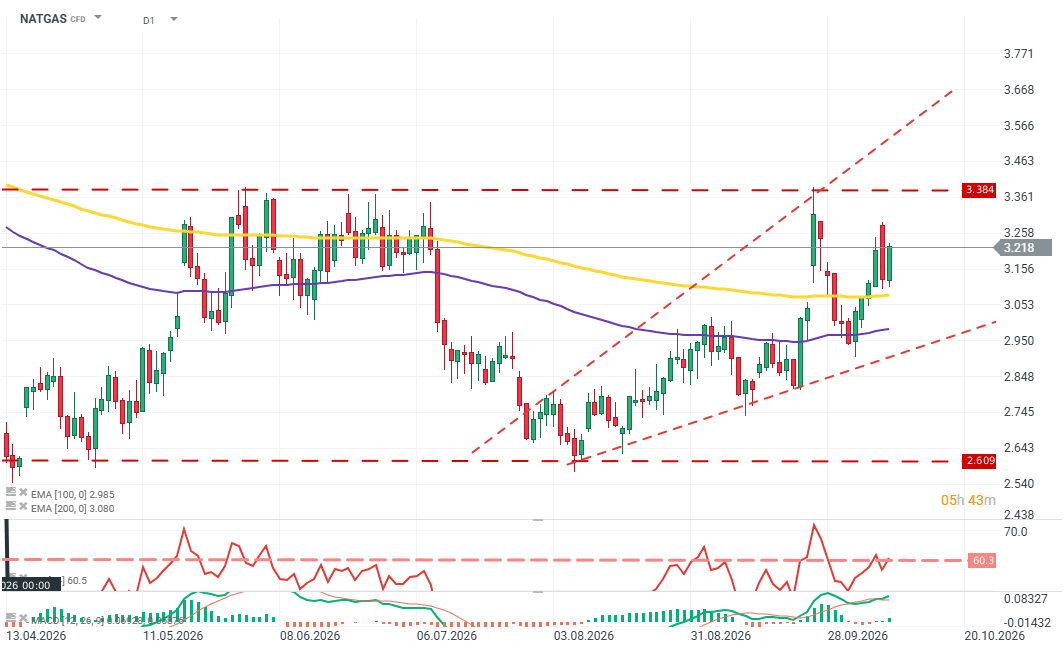
The daily technical picture points to an improving short-term tone, although natural gas remains within a broader consolidation range.
The supplied chart identifies an approximate trading band between $2.60 and $3.40. Recent gains and an RSI (14) reading near 60 suggest that buying momentum has strengthened without reaching traditionally overbought territory.
This leaves room for further upside, but momentum alone is not confirmation of a sustained breakout.
Bullish technical outlook
If prices maintain their recent gains and move towards the upper end of the established range, traders will watch for a sustained break above the $3.40 area.
A confirmed breakout, supported by stronger demand expectations or continued supply disruptions, could indicate that the market is transitioning from consolidation into a more pronounced recovery.
Bearish technical outlook
If prices lose momentum and fall back towards the middle or lower portion of the range, the recent advance may be interpreted as a temporary rebound.
A move towards the $2.60 region would bring the lower boundary of the broader consolidation back into focus. A decisive break below that area would weaken the current technical picture.
These levels are approximate reference points taken from the supplied chart, not guaranteed support or resistance levels. Price action, updated data and volatility conditions may alter their relevance.
Natural Gas Forecast for Monday and the Coming Week
The opening sessions of the week are likely to be shaped by three factors: the pace of recovery in US offshore production, revisions to winter weather forecasts and the next indications of the US storage balance.
The bullish case rests on supply uncertainty coinciding with expectations of stronger seasonal demand. If production disruptions persist and forecasts turn colder, natural gas could attempt to extend last week’s gains.
The bearish case centres on the possibility that supply returns faster than expected while inventories continue to build. In that scenario, the market may struggle to break out of its existing range.
The European market will require a separate assessment, with particular attention to regional storage, LNG availability and changes in the balance between European demand and global supply.
Rather than assuming that the latest gains will continue, market participants should look for confirmation from both fundamental data and price action.
NATGAS (D1)
Analysis — Louis Roche, Today Markets
Natural gas is entering a period in which short-term supply disruptions and longer-term seasonal expectations can have an outsized influence on price movements.
Last week’s rally reflects an increasingly sensitive balance between potential production losses, uncertain winter temperatures and geopolitical risks. Yet the larger-than-expected EIA storage injection demonstrates that the market is not facing an unambiguously tightening supply-demand picture.
The most important development to monitor on Monday is whether the market continues to price in the risk of reduced supply and stronger winter demand, or whether attention shifts back towards comfortable inventories and the prospect of recovering production.
Technically, improving momentum supports the possibility of further gains, but the broad consolidation remains intact until prices establish a more decisive move beyond the established range.
The outlook is therefore cautiously bullish in the short term, conditional on continued supply concerns and supportive weather forecasts. Confirmation will be essential, particularly if prices approach the upper boundary of the current trading range.
Currency Hedger View: Natural Gas and Business Cost Exposure
Natural gas price movements can affect energy-intensive businesses, manufacturers and other companies exposed to changing fuel and electricity costs. The impact varies according to regional pricing, supply contracts, consumption profiles and the extent to which costs are already fixed or hedged.
For businesses operating across borders, commodity volatility can also interact with foreign exchange movements. Changes in energy costs and currency rates may influence supplier invoices, operating margins, procurement budgets and cash-flow forecasts at the same time.
Currency Hedger monitors foreign exchange markets alongside broader commodity and macroeconomic conditions, helping businesses assess and manage their international currency exposure.
Open a Currency Hedger Account
Visit Currency Hedger to learn more about managing international currency exposure.
Coming Sessions: What to Watch
- Weather forecasts: Look for changes in projected temperatures and greater agreement between the ECMWF and GFS models.
- US production: Monitor updates on Gulf of Mexico shut-ins and the pace of offshore supply recovery.
- EIA inventories: Compare future storage injections with seasonal expectations and the overall level of working gas.
- European gas: Assess regional storage, LNG flows and supply-security developments.
- Technical momentum: Watch whether NATGAS sustains its recovery and tests the upper end of the current trading range.
The balance between weather-driven demand and available supply will determine whether natural gas can extend its latest gains. For now, the market has a supportive short-term tone, but confirmation from production data, inventory trends and updated forecasts will be necessary before a sustained breakout can be established.
Disclaimer
This article is for informational and market commentary purposes only and does not constitute investment advice or a recommendation to buy or sell any financial instrument. Natural gas prices can be highly volatile and may respond sharply to weather forecasts, production disruptions, inventory data and geopolitical developments. Past price movements do not guarantee future performance.