Global Markets
S&P 500 — US Large Cap Index
NASDAQ 100 — Tech Growth Index
Dow Jones — Industrial Average
FTSE 100 — UK Blue Chips
Euro Stoxx 50 — Eurozone Leaders
DAX 40 — German Equities
CAC 40 — French Market Index
Nikkei 225 — Japan Benchmark
Hang Seng — Hong Kong Index
Shanghai Composite — China Mainland
ASX 200 — Australian Market
TSX Composite — Canada Index
Nifty 50 — India Large Cap
STI Index — Singapore Market
KOSPI — South Korea Index
Bovespa — Brazil Equities
JSE Top 40 — South Africa Index
IPC Index — Mexico Market

S&P 500 — US Large Cap Index
NASDAQ 100 — Tech Growth Index
Dow Jones — Industrial Average
FTSE 100 — UK Blue Chips
Euro Stoxx 50 — Eurozone Leaders
DAX 40 — German Equities
CAC 40 — French Market Index
Nikkei 225 — Japan Benchmark
Hang Seng — Hong Kong Index
Shanghai Composite — China Mainland
ASX 200 — Australian Market
TSX Composite — Canada Index
Nifty 50 — India Large Cap
STI Index — Singapore Market
KOSPI — South Korea Index
Bovespa — Brazil Equities
JSE Top 40 — South Africa Index
IPC Index — Mexico Market
AED • EUR • GBP • USD IBANs   |   CROSS BORDER FX   |   LOCAL CURRENCIES   |   GLOBAL COVERAGE
Central BanksEconomic CalendarTechnical Analysis

Norges Bank keeps rates unchanged, but leaves the door open to rate hikes. Is this really the end of the NOK strengthening, though?

Key takeaways

  • Norges Bank kept its main interest rate unchanged at 4.5%.
  • Governor Ida Wolden Bache stated that inflation remains too high.
  • Interest rates are expected to stay elevated for an extended period.

Norges Bank kept its main interest rate unchanged at 4.5% today, which was clearly expected by the market. Swaps prior to the decision were pricing in only about a 4% chance of a rate hike. This was an interim meeting, so the bank did not publish new projections or a rate path. However, the message remained hawkish, which also aligns with the sentiment presented by Riksbank, which hiked rates yesterday and will be catching up with Norges Bank’s decision. Governor Ida Wolden Bache stated that “inflation is too high” and that interest rates will likely need to be kept at an elevated level for some time. She added that the bank is ready to raise them if necessary. According to policymakers, restrictive monetary policy is still necessary to bring inflation down to the 2% target within a reasonable time horizon.
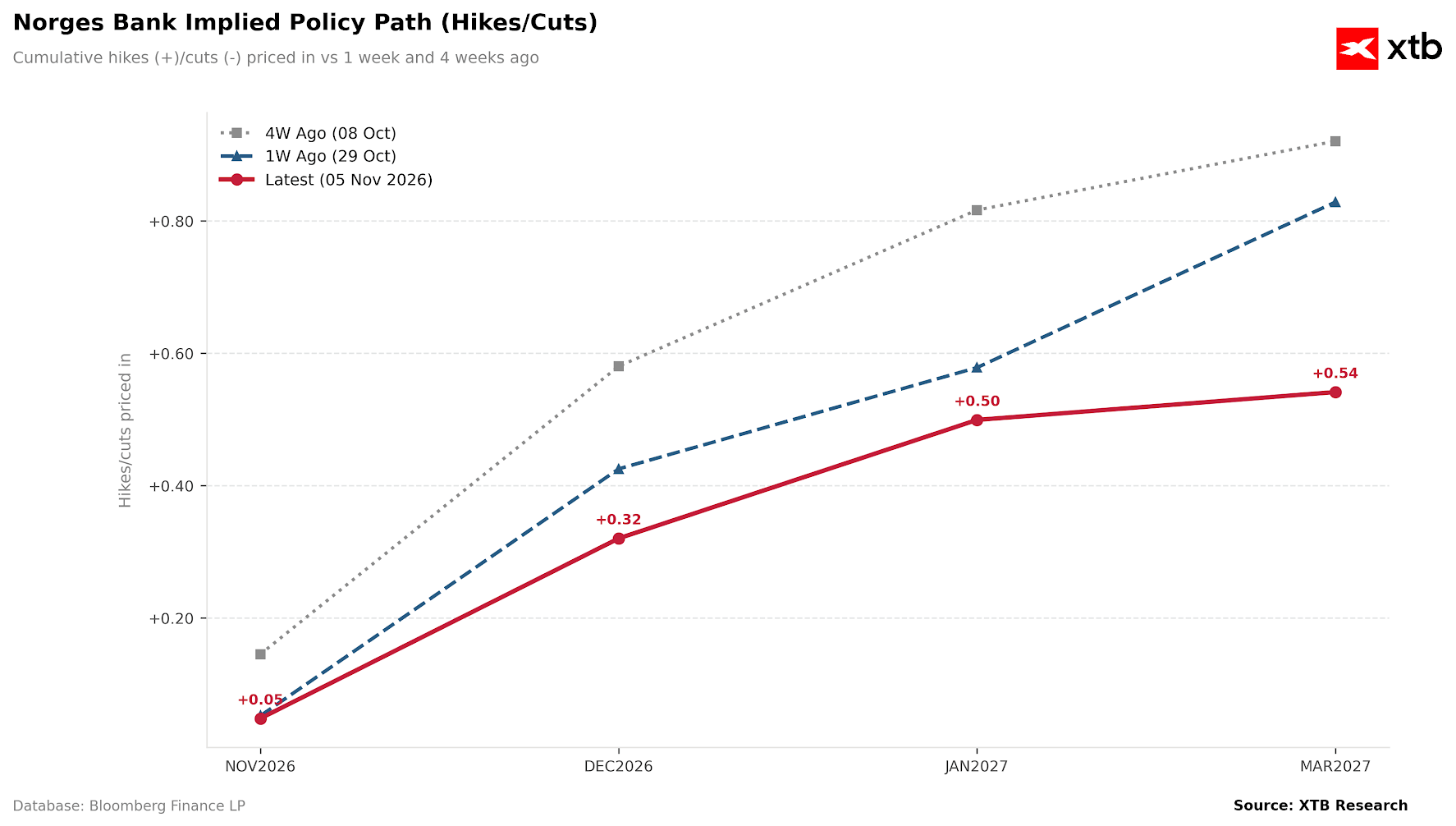
Just a month ago, expectations for another rate hike in March were very high. Currently, they have dropped to around 50%. Source: Bloomberg Finance LP, XTB Inflation in Norway for September remains elevated at 3.4%, but the trend remains sideways when looking at recent years. The inflation peak was reached in 2022 above 7%. Norges Bank has already raised rates by a total of 50 bps this year, most recently by 25 bps in September. Core inflation has remained around 3% for about two years, and unemployment is near multi-year lows. On the other hand, the bank noted that the krone has strengthened and is stronger than assumed. The exchange rate against the euro is at its highest level in four years, which limits the risk of imported inflation, while the economy is slowing under the impact of higher borrowing costs. This may mean that further rate hikes are by no means certain, especially as crude oil prices drop, which could also weigh negatively on the entire Norwegian economy. Before the decision, the market was pricing in about 9 bps of rate hikes in December, compared to 16 bps a week earlier. Most economists believe that 4.5% is the peak of the cycle and expect the first rate cut in Q4 2027. Nordea is more cautious and sees no signs of cuts before 2028. However, if greater pressure on oil and gas prices emerges, potential interest rate cuts could arrive in the second half of 2027. Norway stands out compared to other central banks. The Bank of Sweden and the Reserve Bank of Australia raised interest rates this week, while Norges Bank decided only to maintain readiness for action.
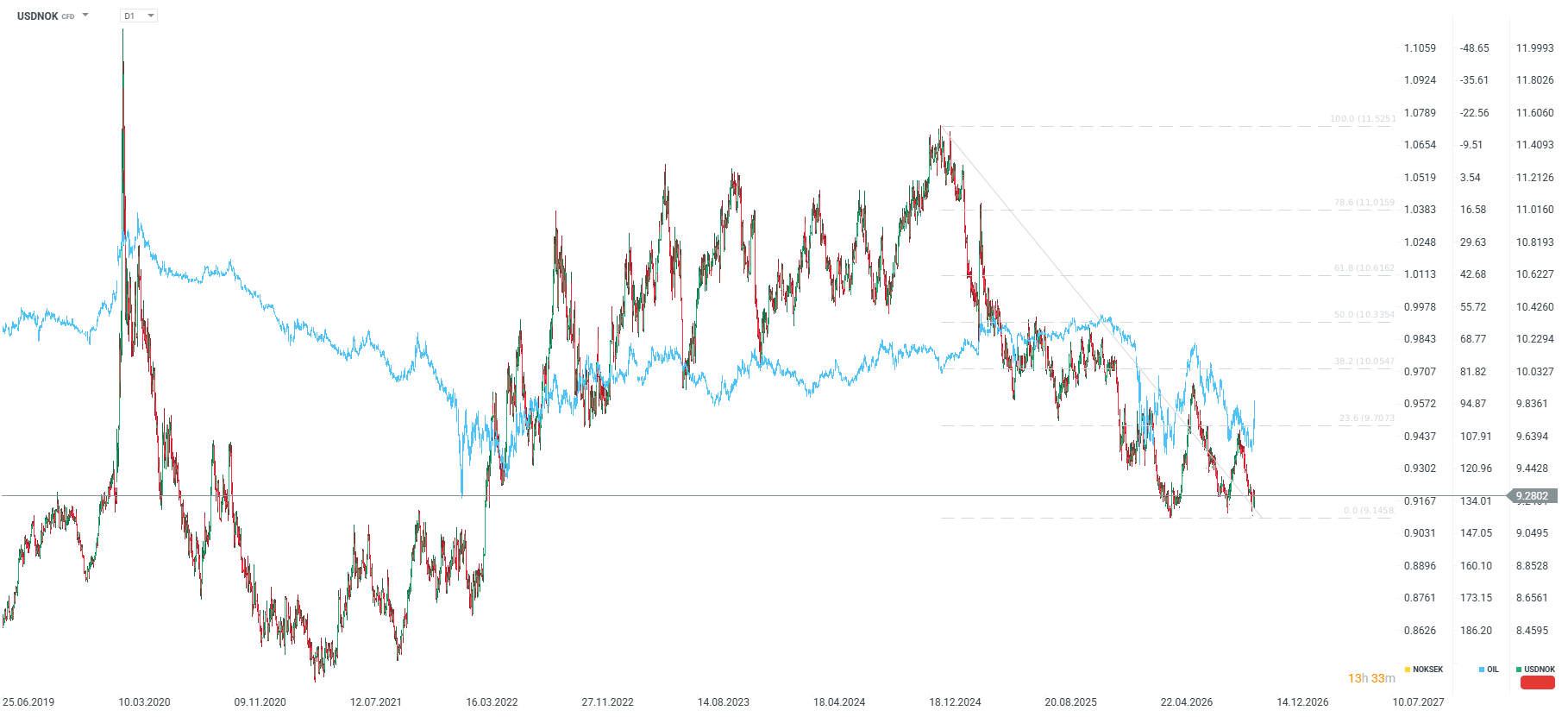
Since the beginning of 2026, the correlation between the NOK and crude oil has been very strong, while the monetary effect was visible primarily after 2024. Nevertheless, it can currently be expected that we may have already reached the peak in interest rates, whereas hikes could still take place in the EMU and the US, and additionally, falling oil prices could act to the disadvantage of the NOK. Technically, it is also visible that the area around 9.2 constitutes a very important support level. A fall in crude oil prices towards $80 could lead to a rebound in USDNOK towards 9.60.

Register a Revolut Business Account
```

Market Analysis & Disclaimer

The market information, analysis, commentary, forecasts and opinions contained in this publication are provided by Octalas Group Ltd on behalf of Today Markets and Currency Hedger using information and data obtained from sources believed to be reliable. However, Octalas Group Ltd, Today Markets and Currency Hedger do not warrant or guarantee the accuracy, completeness or timeliness of the information presented and accept no responsibility for any loss or damage arising from reliance upon information contained herein, to the extent permitted by applicable law.

Market forecasts, expectations and opinions are based on analysis of available information and a number of assumptions regarding economic, financial, political and market conditions. Such assumptions may prove to be incorrect, and actual market developments may differ materially from those described or anticipated.

Nothing contained in this publication constitutes investment advice, financial advice, a personal recommendation, an offer, solicitation or invitation to buy, sell or otherwise transact in any financial instrument or investment product. The information is provided for general informational and educational purposes only and does not take into account the investment objectives, financial situation, experience or particular circumstances of any individual reader.

Past performance is not indicative of future results. Financial markets, including foreign exchange, commodities, equities, derivatives and other financial instruments, involve risk and prices can move rapidly. Readers should conduct their own independent research and, where appropriate, obtain advice from an appropriately authorised financial professional before making any investment or trading decision.

Where this publication refers to Today Markets, it represents market news, research, analysis and commentary published for informational purposes. Where Currency Hedger is referenced, it represents commentary concerning foreign exchange, currency exposure, international payments and hedging-related topics. References to particular financial instruments, markets, companies, currencies or commodities should not be interpreted as a recommendation to transact in them.

Octalas Group Ltd, Today Markets and Currency Hedger may have commercial interests or relationships with businesses, financial-service providers, technology providers or other market participants mentioned in their publications. Where relevant, such relationships or interests may create potential conflicts of interest. Appropriate measures are intended to be taken to ensure that published analysis and commentary are presented objectively and that commercial considerations do not determine the substance of market analysis.

The views expressed in this publication are those of the author or contributors at the time of publication and may change without notice as market conditions develop. Readers should not assume that any information contained herein has been updated following publication.

Related Articles

Leave a Reply

Your email address will not be published. Required fields are marked *

Check Also
Close
Back to top button