Global Markets
S&P 500 — US Large Cap Index
NASDAQ 100 — Tech Growth Index
Dow Jones — Industrial Average
FTSE 100 — UK Blue Chips
Euro Stoxx 50 — Eurozone Leaders
DAX 40 — German Equities
CAC 40 — French Market Index
Nikkei 225 — Japan Benchmark
Hang Seng — Hong Kong Index
Shanghai Composite — China Mainland
ASX 200 — Australian Market
TSX Composite — Canada Index
Nifty 50 — India Large Cap
STI Index — Singapore Market
KOSPI — South Korea Index
Bovespa — Brazil Equities
JSE Top 40 — South Africa Index
IPC Index — Mexico Market
S&P 500 — US Large Cap Index
NASDAQ 100 — Tech Growth Index
Dow Jones — Industrial Average
FTSE 100 — UK Blue Chips
Euro Stoxx 50 — Eurozone Leaders
DAX 40 — German Equities
CAC 40 — French Market Index
Nikkei 225 — Japan Benchmark
Hang Seng — Hong Kong Index
Shanghai Composite — China Mainland
ASX 200 — Australian Market
TSX Composite — Canada Index
Nifty 50 — India Large Cap
STI Index — Singapore Market
KOSPI — South Korea Index
Bovespa — Brazil Equities
JSE Top 40 — South Africa Index
IPC Index — Mexico Market
AED • EUR • GBP • USD IBANs   |   CROSS BORDER FX   |   LOCAL CURRENCIES   |   GLOBAL COVERAGE
NZDTechnical AnalysisUSD

NZD/USD Extends rejection slide from 50% Fibo.; drops to 0.5900 neighbourhood

  • NZD/USD drifts lower despite stronger NZD CPI print and snaps a six-day winning streak.
  • A modest USD uptick fails to assist spot prices to make it through the 50% Fibo. level.
  • The bullish technical setup supports prospects for the emergence of some dip-buying.

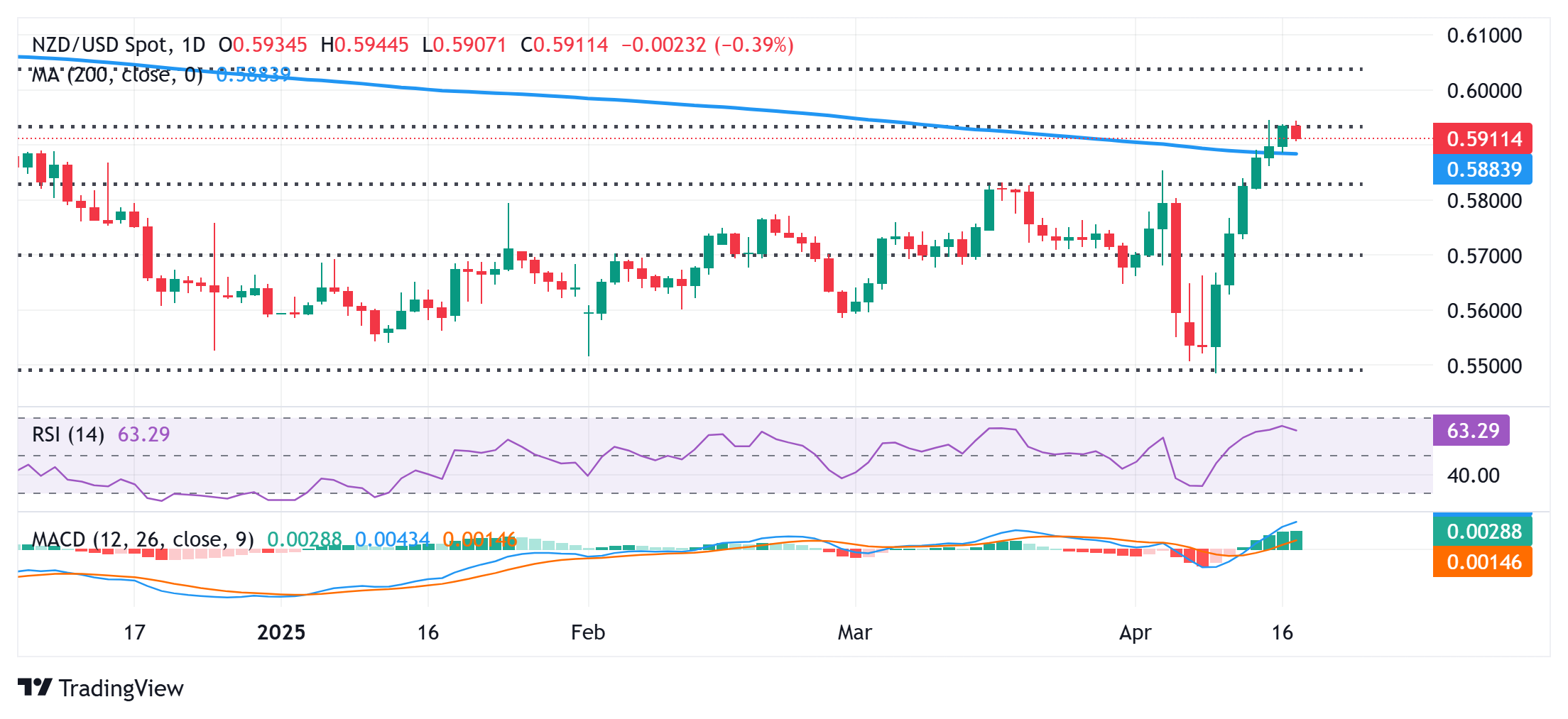
The NZD/USD pair retreats from the vicinity of mid-0.5900s, or a fresh year-to-date high touched during the Asian session this Thursday, in reaction to stronger-than-expected consumer inflation figures from New Zealand. Spot prices drop to the 0.5900 neighbourhood in the last hour and for now, seem to have snapped a six-day winning streak amid a modest US Dollar (USD) uptick.

Furthermore, the fact that the Consumer Price Index (CPI) remained comfortably within the Reserve Bank of New Zealand’s (RBNZ) 1–3% target range for a third consecutive quarter failed to shift expectations of further easing. This undermines the New Zealand Dollar (NZD) and contributes to the NZD/USD pair’s slide from the 50% Fibonacci retrancement level of the September 2024-April 2025 downfall.

Meanwhile, the recent breakout through the very important 200-day Simple Moving Average (SMA) for the first time since October 2024 was seen as a key trigger for bullish traders. Moreover, oscillators on the daily chart are holding comfortably in positive territory and are still away from being in the overbought zone. This, in turn, suggests that the path of least resistance for the NZD/USD pair is to the upside.

Hence, any subsequent fall might still be seen as a buying opportunity near the 0.5860-0.5855 region. This is closely followed by the 200-day SMA, currently around the 0.5840 zone, and the 0.5825 region, or the 38.2% Fibo. level, which should help limit any further decline. A convincing break below the latter, however, might prompt technical selling and drag the NZD/USD pair towards testing sub-0.5800 levels.

On the flip side, bulls might wait for sustained strength and acceptance above the 50% Fibo. level, around the 0.5930 region, before placing fresh bets. The NZD/USD pair might then accelerate the positive momentum towards the 0.5970 horizontal resistance en route to the 0.6000 psychological mark and the 61.8% Fibo. level, around the 0.6040 area.

NZD/USD daily chart
Register a Revolut Business Account
```

Market Analysis & Disclaimer

The market information, analysis, commentary, forecasts and opinions contained in this publication are provided by Octalas Group Ltd on behalf of Today Markets and Currency Hedger using information and data obtained from sources believed to be reliable. However, Octalas Group Ltd, Today Markets and Currency Hedger do not warrant or guarantee the accuracy, completeness or timeliness of the information presented and accept no responsibility for any loss or damage arising from reliance upon information contained herein, to the extent permitted by applicable law.

Market forecasts, expectations and opinions are based on analysis of available information and a number of assumptions regarding economic, financial, political and market conditions. Such assumptions may prove to be incorrect, and actual market developments may differ materially from those described or anticipated.

Nothing contained in this publication constitutes investment advice, financial advice, a personal recommendation, an offer, solicitation or invitation to buy, sell or otherwise transact in any financial instrument or investment product. The information is provided for general informational and educational purposes only and does not take into account the investment objectives, financial situation, experience or particular circumstances of any individual reader.

Past performance is not indicative of future results. Financial markets, including foreign exchange, commodities, equities, derivatives and other financial instruments, involve risk and prices can move rapidly. Readers should conduct their own independent research and, where appropriate, obtain advice from an appropriately authorised financial professional before making any investment or trading decision.

Where this publication refers to Today Markets, it represents market news, research, analysis and commentary published for informational purposes. Where Currency Hedger is referenced, it represents commentary concerning foreign exchange, currency exposure, international payments and hedging-related topics. References to particular financial instruments, markets, companies, currencies or commodities should not be interpreted as a recommendation to transact in them.

Octalas Group Ltd, Today Markets and Currency Hedger may have commercial interests or relationships with businesses, financial-service providers, technology providers or other market participants mentioned in their publications. Where relevant, such relationships or interests may create potential conflicts of interest. Appropriate measures are intended to be taken to ensure that published analysis and commentary are presented objectively and that commercial considerations do not determine the substance of market analysis.

The views expressed in this publication are those of the author or contributors at the time of publication and may change without notice as market conditions develop. Readers should not assume that any information contained herein has been updated following publication.

Related Articles

Leave a Reply

Your email address will not be published. Required fields are marked *

Back to top button