S&P 500 — US Large Cap Index
 FTSE 100 — UK Blue Chips
 Euro Stoxx 50 — Eurozone Leaders
 DAX 40 — German Equities
 CAC 40 — French Market Index
 Nikkei 225 — Japan Benchmark
 Hang Seng — Hong Kong Index
 Shanghai Composite — China Mainland
 ASX 200 — Australian Market
 TSX Composite — Canada Index
 Nifty 50 — India Large Cap
 STI Index — Singapore Market
 KOSPI — South Korea Index
 Bovespa — Brazil Equities
 JSE Top 40 — South Africa Index
 IPC Index — Mexico Market
The US imposes harsh sanctions on Russia’s two largest oil companies, threatening a reduction in global supply availability.
On October 22, the United States, specifically Donald Trump, decided to impose comprehensive sanctions on Rosneft and Lukoil—Russia’s two largest oil conglomerates. This marks the Trump administration’s first significant action against the Russian energy sector since the President’s return to the White House. This move is seen as a 180-degree shift from the US President’s recent communication, where he had expressed satisfaction with talks with Putin and urged Ukraine to abandon the fight for certain territories. Now, the US aims to pressure Russia towards a ceasefire, with Ukrainian President Zelensky indicating a high probability of a ceasefire but without any declaration of yielding territory.
US Sanctions Imposed on Russian Companies:
- Executive Order 14024 – sanctions imposed under the executive order concerning Russia’s harmful activities.
- Asset Freezing – all assets of both companies in the US or under the control of US persons have been blocked.
- Transaction Ban – US citizens and companies are prohibited from conducting any financial transactions with the sanctioned conglomerates.
- $50\%$ Rule – all entities controlled by at least $50\%$ by Rosneft or Lukoil are automatically subject to sanctions.
- 34 Subsidiaries – OFAC listed companies including Sibneftegaz, Bashneft-Dobicha, Lukoil-Perm, Lukoil-Kaliningradmorneft, RN-Yuganskneftegaz, and RITEK.
Threat of Secondary Sanctions:
- Foreign banks conducting significant transactions with Rosneft or Lukoil may themselves become subject to secondary sanctions.
- Non-US financial institutions processing transactions with the Russian companies lose access to the US financial system if they service sanctioned entities.
- The goal is to limit oil imports from Russia by third countries—primarily China and India, which together imported approximately 2.2 million barrels per day (bpd) from the two companies in the first half of 2025.
- Treasury Secretary Scott Bessent warned of further action and called for allied cooperation. The EU is imposing another sanctions package, indicating it will forgo Russian LNG gas from 2027.
- Trump announced a conversation with President Xi Jinping regarding Russian oil purchases.
- Transactions with Lukoil and Rosneft will be permitted until November 21, 2025.
- This grace period is intended to allow companies to adjust to the new requirements.
Economic Consequences:
- Oil prices have staged a strong rebound in recent days. This week’s gain is over 5%.
- Export Scale – Rosneft and Lukoil account for nearly half of Russian oil exports, approximately 3.1 million bpd.
- Budget Revenue – the Russian oil and gas sector constitutes about 25% of the Russian federal budget revenue.
- India – the largest buyer of Russian seaborne oil has initiated a contract review; state-owned refineries may be forced to withdraw from Russian supplies.
- China – imports about 20% of its oil from Russia (approximately 2 million bpd), with refineries in Shandong province and CNPC particularly vulnerable.

India imports nearly 2 million bpd from Russia by sea. Representatives of Indian refineries indicate it will now be virtually impossible to purchase Russian oil. Source: Bloomberg Finance LP, XTB

Recently, we have observed a significant increase in the amount of oil at sea, which is disproportionate even to the high market oversupply. This may be the result of India withdrawing from purchasing Russian oil. Source: Bloomberg Finance LP, XTB
Geopolitical Context:
- The sanctions were announced the day after the cancellation of the Trump-Putin meeting in Hungary.
- Trump stated he had “waited a long time” and did not want a “wasted meeting” without progress in peace talks.
- The EU simultaneously adopted its 19th sanctions package, including a ban on Russian LNG imports from 2027 and restrictions on 117 vessels from the shadow fleet.
Oil Market Fundamentals:
- The current market oversupply is nearly 4 million bpd. The surplus has been growing since the start of this year. The current situation resembles the late $1990$s or the $2014-2016$ period, which also saw a massive market surplus. Price declines were significantly steeper during those periods than they are now, though the current oversupply has been present, with few interruptions, since $2022$.
- The IEA expects the oversupply to persist at around 4 million bpd next year, but the current situation may change that picture. India and potentially China are not easily replaced as oil export destinations. Previously, these two large countries replaced the entire European Union as the main recipient. This potentially threatens to reduce the available supply on the market by 2-4 million bpd, although smaller countries will certainly be found that may buy Russian oil in smaller quantities, using older, uninsured fleets. The downward trend in the oil market should continue, but the oversupply next year may certainly be smaller than the IEA anticipates.

The current oversupply situation is reminiscent of the late $1990$s or the $2014-2016$ period. While the surplus may decrease due to sanctions on Russia, it will most likely still be present, which could place pressure on prices. Source: Bloomberg Finance LP
Technical Situation:
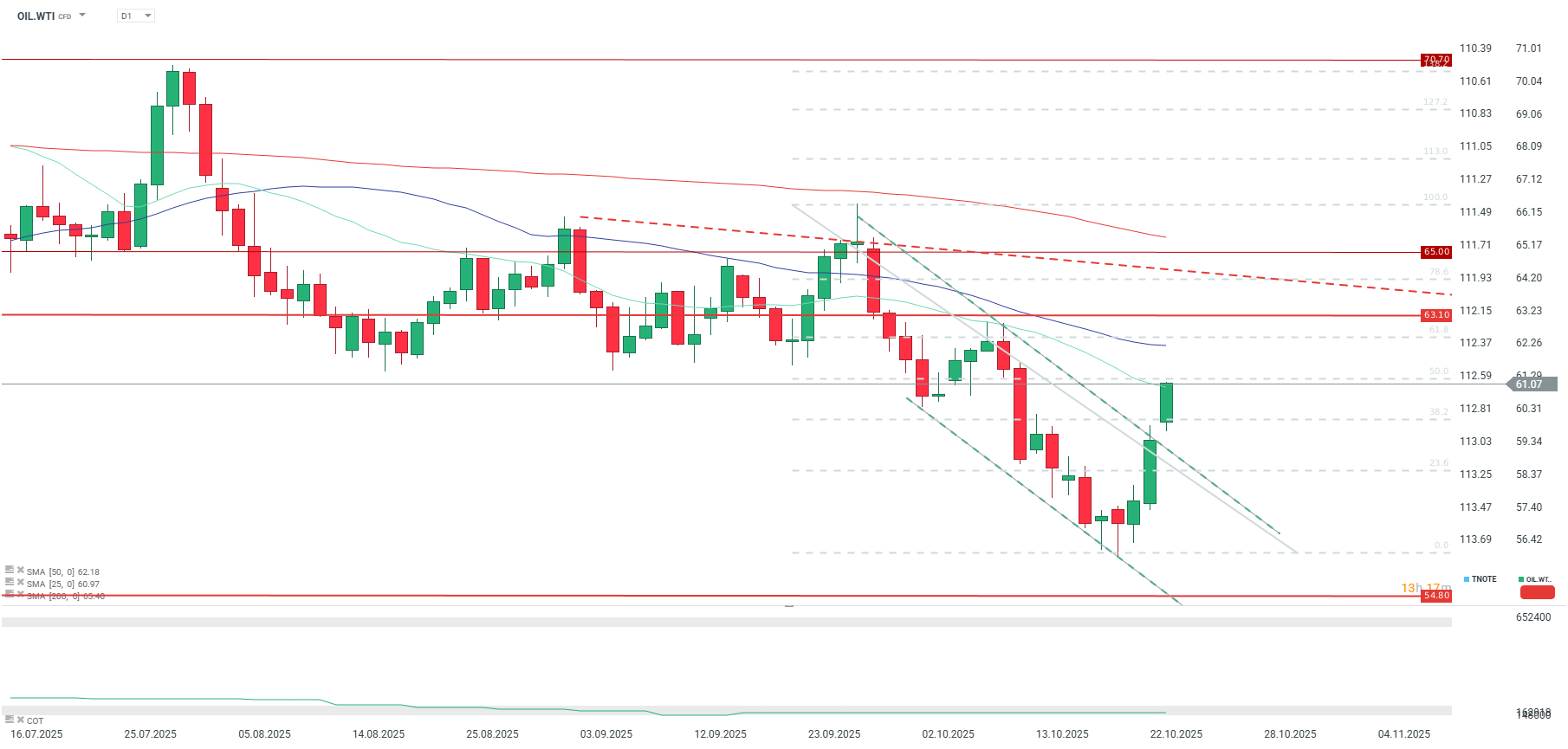
The price is up over 2% today, testing the 25-period moving average. The upward momentum could lead to a rise towards $62 per barrel, where the 50-period moving average is located. However, it should not exceed the zone around $63-$65 per barrel, which contains the downtrend line and the range of previous consolidation from August and September. If, however, the current sanctions prove to be a “paper tiger” (possible further assurances from Putin and cancellation of sanctions, or continued broad Russian exports), the price may once again drop to the vicinity of $57 and permanently settle below $55 per barrel next year.
The material on this page does not constitute financial advice and does not take into account your level of understanding, investment objectives, financial situation or any other specific needs. All information provided, including opinions, market research, mathematical results and technical analyzes published on the Website or transmitted To you by other means, it is provided for information purposes only and should in no way be construed as an offer or solicitation for a transaction in any financial instrument, nor should the information provided be construed as advice of a legal or financial nature on which any investment decisions you make should be based exclusively To your level of understanding, investment objectives, financial situation, or other specific needs, any decision to act on the information published on the Website or sent to you by other means is entirely at your own risk if you In doubt or unsure about your understanding of a particular product, instrument, service or transaction, you should seek professional or legal advice before trading. Investing in CFDs carries a high level of risk, as they are leveraged products and have small movements Often the market can result in much larger movements in the value of your investment, and this can work against you or in your favor. Please ensure you fully understand the risks involved, taking into account investments objectives and level of experience, before trading and, if necessary, seek independent advice.