S&P 500 — US Large Cap Index
 FTSE 100 — UK Blue Chips
 Euro Stoxx 50 — Eurozone Leaders
 DAX 40 — German Equities
 CAC 40 — French Market Index
 Nikkei 225 — Japan Benchmark
 Hang Seng — Hong Kong Index
 Shanghai Composite — China Mainland
 ASX 200 — Australian Market
 TSX Composite — Canada Index
 Nifty 50 — India Large Cap
 STI Index — Singapore Market
 KOSPI — South Korea Index
 Bovespa — Brazil Equities
 JSE Top 40 — South Africa Index
 IPC Index — Mexico Market

Key takeaways
- Escalation in the Middle East shatters ceasefire
- Oil -price is elevated, but pulls back from Monday’s high
- European and Asian stocks at risk
- Yen intervention back on the cards, could others follow?
- Should investors ‘Sell in May and go away?’
- Is Warren Buffet right, as GameStop makes bid for eBay?
- Earnings watch
- NFPs in focus
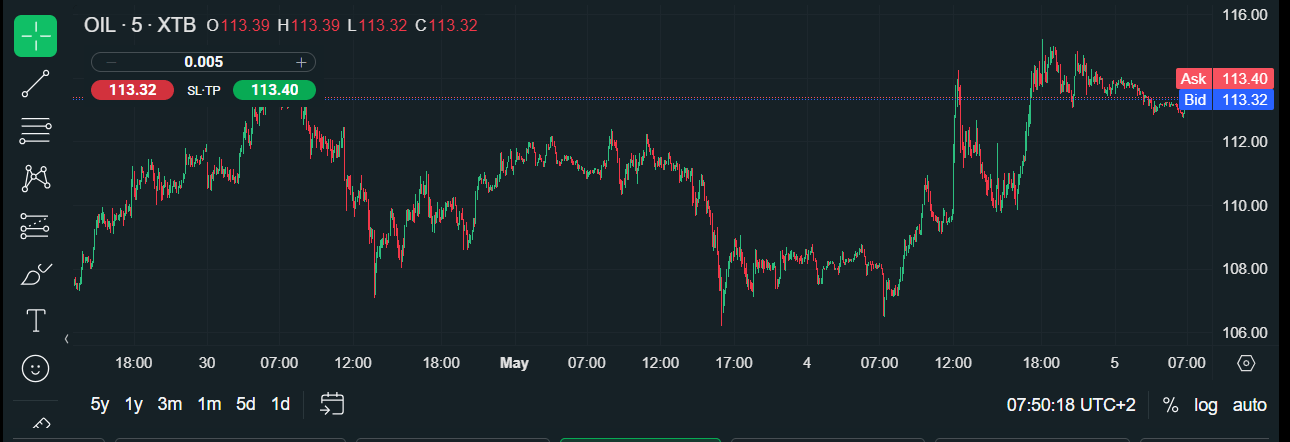
The Week Ahead: Is the ceasefire over? The oil price is falling back this morning after Monday’s surge. Brent crude is lower by 1% and is trading around $113 per barrel, stocks slid in Asia, and futures prices point to a weaker open in Europe. However, for now stock futures in the US are stable. The oil price surged on Monday, after the war in the Middle East escalated and Iranian missiles struck the UAE for the first time in weeks. The attack on a UAE oil port sent oil prices surging 5%, and Brent crude traded above $114.00 per barrel. Iran also hit several ships in the Strait of Hormuz. However, there are signs that the US is loosening Iran’s blockade of the Strait and that ship are managing to pass through the Strait, albeit at a much slower pace than before the war. Events over the last 24 hours are the most serious escalation of the conflict since the ceasefire came into effect in early April, and this is a highly changeable situation.
Oil price surge here to stay
Iran has announced that it will be extending the area it controls around the Strait of Hormuz to include UAE ports including Fujairah. This suggests that the conflict is broadening across the Gulf once more, Although the oil price is falling today, until there is a lasting solution to reopen the Strait of Horuz, the oil price is likely to remain elevated and Brent crude could stay above $110 per barrel. The rhetoric from Iran and the US suggests that more violence is likely before any diplomatic solution can be found. Aside from the surge in oil prices, stocks slid globally on Monday.
The Dax fell more than 1%, however, there were milder declines for the S&P 500 and the Nasdaq, which both sold off by 0.4% and 0.2%, respectively. This is hardly a rout, and suggests two things: firstly, that fundamental factors like earnings continue to support global risk appetite for stocks, especially in the US, and secondly, that another surge in the oil price, especially if it is prolonged, could hurt European and Asian equities harder than US indices due to the economic impact from the war hitting Europe and Asia harder than the US. This theme is only likely to develop further this year, especially if the situation is not resolved in the next few weeks. Of course, part of the relative calm in stock markets could be an expectation that Donald Trump will intervene in some way to deescalate the situation, especially if we see continued high gas prices in the US. However, with no sign that this will happen yet, it is another volatile start to the week.
Chart 1: Brent crude oil price
Source: XTB
As we move through the first full trading week of May, there are two main themes dominating market sentiment: 1, the war in Iran and 2, FX market intervention, after the yen jumped on Monday, sparking more talk about official Japanese intervention in the currency.
The oil price and FX intervention risks
A surging oil price, which has risen by more than 88% YTD, is seeping into other markets. The yen has come under intense pressure during the Iran/ US war, as it struggles with a flight to the safety of the dollar and concerns about inflation and economic growth. Japan is a net importer of commodities, so when oil prices rise, it weighs on the economic outlook and causes the yen to weaken. However, yen downside came to an abrupt halt last week, after rumours of official intervention to prop up the currency started to surface.
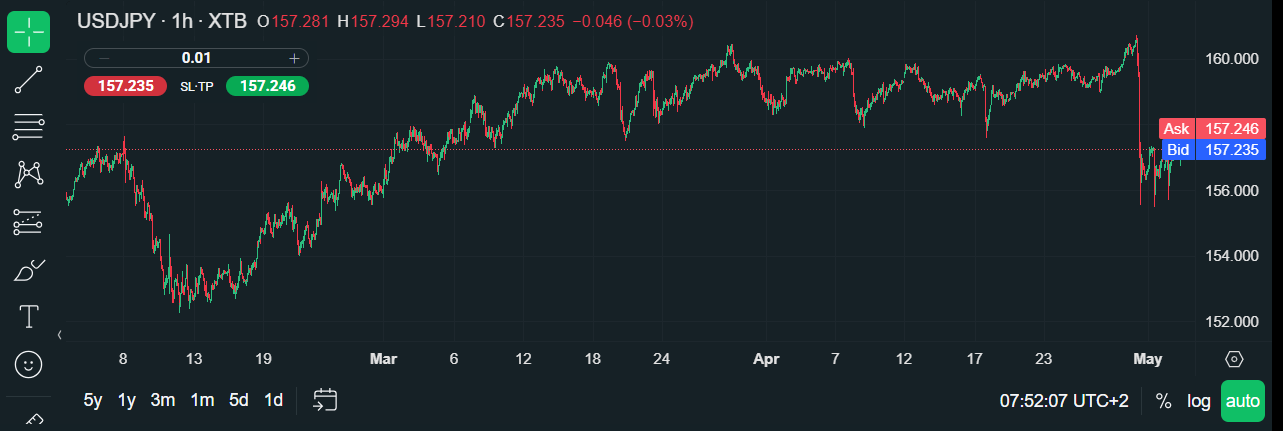
USD/JPY fell more than 1.5% on the back of this, the biggest weekly jump in the yen since February. Intervention speculation continued at the start of this week, after a sharp intraday swing lower in USD/JPY on Monday. The recent price action suggests that Japanese officials are drawing a line in the sand for USD/JPY at 160, and do not want it going above this level, as it will add upside pressure to inflation. Although there is no official confirmation, the Japanese authorities bought yen for the first time in two years last week. The question now is, will volatility pick up in the FX market as other central banks, particularly in Asia, contemplate official currency intervention to prop up their currencies during this period of geopolitical stress? Also, for this intervention to work, will the US authorities support Japan in its efforts to quell yen weakness?
Chart 2: USD/JPY
Source: XTB
There is also a bias for tightening monetary policy after the Bank of Australia hiked interest rates for the second time on Tuesday. The Aussie interest rate is now 4.35%, due to a concern about persistent inflation and a strong economic backdrop. The Aussie dollar is weaker on the back of this decision, although it is one of the strongest currencies in the G10 YTD, rising more than 7% vs. the USD.
European autos have mild reaction to Trump’s latest tariffs
US stocks turned lower on Monday, after reaching record highs at the end of last week. The Dax dropped more than 1% as the situation in the Middle East deteriorated, there were also declines of more than 2% for BMW and 3% for Mercedez Benz, after President Trump slapped an extra 25% tariff on autos from the EU. In the past, the market may have had a more aggressive reaction to tariffs, but these days they are considered a secondary concern.
The President is constantly adjusting tariff rates, so the market is unwilling to price in the long term impact of an additional 25% levy on the likes of Porche, BMW and Mercedez. Of a bigger concern is rising gas prices and the essential closure of the lucrative Middle Eastern market. This is why BMW and Mercedez Benz’s share prices are both lower by nearly 20% so far this year.
Should investors ‘Sell in May, and go away?’
Elsewhere, after the turbulent start to the year, it could be tempting for investors to ‘sell in May, and go away’, but should they? Warren Buffet said at the weekend, that he was very comfortable with Berkshire Hathaway’s record $397bn cash pile, as the company feels that the investing environment is not ideal as they wait for more attractive entry points. Buffet, the former CEO of Berkshire, is a fan of a bargain, and with stocks at record highs, the uber conservative investment firm is unsurprisingly sitting on the sidelines. Buffet mentioned concerns about a ‘gambling mentality’ in stock markets right now, so it would be interesting to hear what his thoughts are regarding GameStop’s audacious offer to buy eBay for $125 per share, or $55.5bn.
This is a non-binding offer, which could be financed by 50% cash, and 50% GameStop shares. The offer price is a 20% premium on eBay’s share price, and the stock popped higher by 5% on Monday. This deal raises multiple questions, not least why is a meme stock offering to buy eBay? How can a company that is worth $12bn try to buy eBay for $56bn? The company has apparently secured a loan from TD Bank for $20bn, but unsurprisingly GameStop’s share price fell by more than 10% on Monday. Investors will rightly wonder how a meme stock can try to grow a mature consumer business like eBay, maybe it is no wonder Berkshire Hathaway is staying out of the markets for now. Aside from the war in Iran, there is plenty of corporate and economic news for investors to digest this week, as we explain below.
1, Earnings season
While M&A news triggers stock market volatility at the start of this week, this is also a big week for earnings data, with 100 US companies reporting earnings this week. This includes AMD, Super Micro Computer, the bitcoin Treasury company, Palantir, Walt Disney and McDonalds. AMD, the chip maker, will be in focus when it reports its earnings later today. The company will need to give a very bullish outlook to justify the 60% rise in its share price so far this year. The company has a P/E ratio of more than 130 times earnings, in the past this has not been a problem, as investors had grown used to tech firms trading at high multiples compared to earnings. However, questions over the sustainability of AI investments and a global economic slump has left investors hungry for profits and strong guidance.
Analysts expect some good numbers from AMD, including $10.27bn in revenues for last quarter, up 34% in a year. The company is also expected to confirm that revenue will grow by 32% this quarter, and expectations are high after strong results for Intel last month. Market sentiment towards the graphics processing sector has been positive this year, however, the stock slipped on Monday, and fell more than 5%, which could be a sign of nervousness ahead of today’s earnings release. Overall, US stocks, have been boosted by a strong earnings season so far. 63% of companies listed on the S&P 500 have now reported earnings for last quarter, and 84% of them have beaten analyst estimates for Earnings per Share. The 10-year average is 78%. Companies are also reporting earnings that are 20% above estimates, while the long run average is 7%.
So far, the YoY earnings rate for the S&P 500 is 27.1%, the highest level since Q4 2021. This has been led by a strong season for communication services, tech, and the consumer discretionary sector, which has seen its earnings jump by 39% YoY. The hyperscalers were the largest contributors to the surge in earnings growth last week, and this corresponded with another record high for the Nasdaq and the S&P 500.However, the market has not rewarded all of the Magnificent 7 equally, and Meta saw its share price fall 10% last week, even though it reported stronger earnings growth. Overall, the outperformance of US stocks vs. their European counterparts is becoming entrenched as we move through Q2. The S&P 500 is higher by 11% in the past month, while the FTSE 100 is up by 1.8% and the Dax is higher by 5.5%.
Earnings growth in Europe has been decent but noticeably subdued compared to the US. Stocks listed on the Eurostoxx 600 index were expected to deliver 4% earnings growth for last quarter, but strip out the energy sector, and earnings growth is a mere 1.5% so far. Banks, the limited number of tech stocks and energy have been bright spots for Europe this earnings season, in contrast, luxury has been mixed and autos remain under pressure, which is limiting stock market upside. The underlying growth story is starting to fray outside of energy and financials, which does not bode well for European indices in the medium term.
2, NFP focus
Economic data is also in focus this week, the highlight will be US labour market data that is due on Friday. US trade figures, ISM services report, Jolts jobs survey, and the ADP private sector payrolls report are also on the ticket for this week. NFP’s always steal the limelight. The market is expecting a 60k increase in payrolls for April, and the unemployment rate is expected to remain steady at 4.3%. If correct, this would be a sharp slowdown in jobs growth compared to the 178k jobs growth for March, however, we think that it will take a much weaker jobs number to persuade the Fed to cut rates once more. Last week we heard that 3 Fed members dissented against keeping an easing bias in the Fed’s statement, and inflation is a growing concern at the Fed. There is currently only a very slim chance of a near term rate cut, with the market expecting rates to remain unchanged for the rest of the year, even if the Fed’s March Dot Plot is still expecting to cut rates once in 2026.