S&P 500 — US Large Cap Index
 FTSE 100 — UK Blue Chips
 Euro Stoxx 50 — Eurozone Leaders
 DAX 40 — German Equities
 CAC 40 — French Market Index
 Nikkei 225 — Japan Benchmark
 Hang Seng — Hong Kong Index
 Shanghai Composite — China Mainland
 ASX 200 — Australian Market
 TSX Composite — Canada Index
 Nifty 50 — India Large Cap
 STI Index — Singapore Market
 KOSPI — South Korea Index
 Bovespa — Brazil Equities
 JSE Top 40 — South Africa Index
 IPC Index — Mexico Market
Alphabet shares are down 22% from their all-time high. Is Google ready to resume its bull run?

Key takeaways
- Alphabet (GOOGL.US) shares are down more than 20% from their all-time high of around $407 per share.
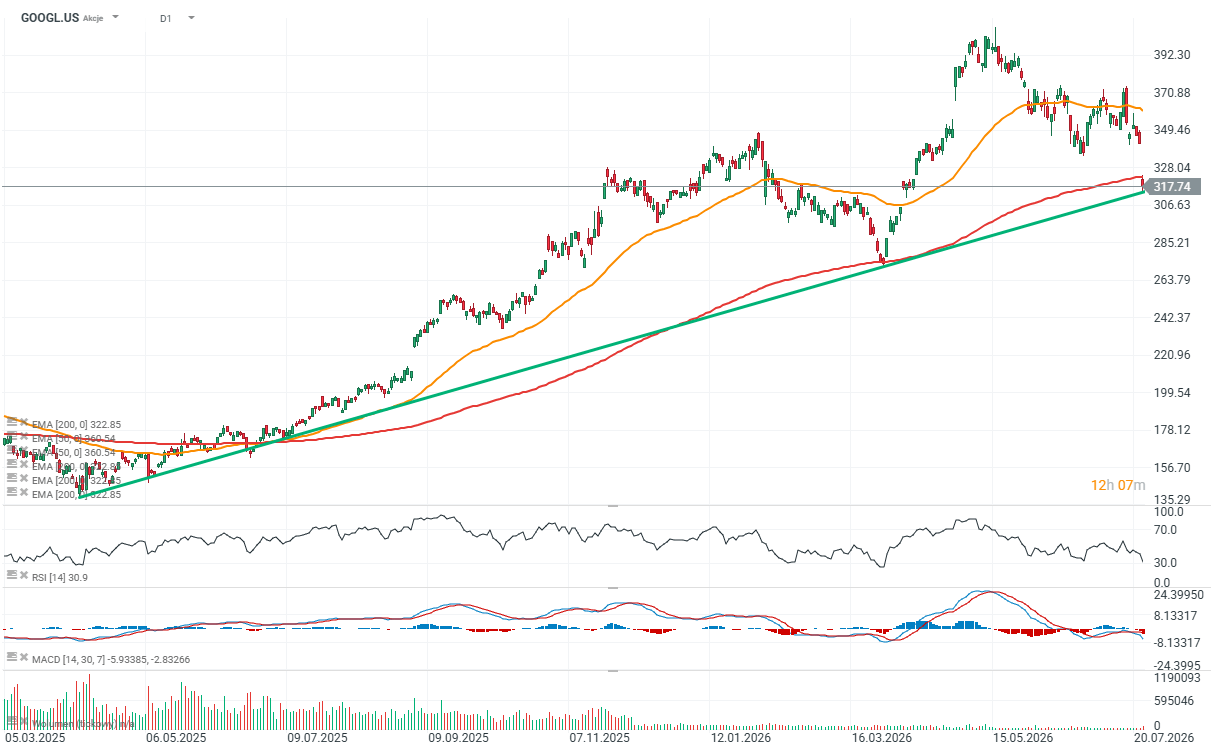
- The stock fell below its 200-day exponential moving average (EMA200) yesterday.
- The company continues to deliver strong growth in its cloud business, while its fundamental valuation still appears relatively attractive.
- Free cash flow (FCF) turned negative last quarter for the first time since Alphabet’s IPO, primarily due to record AI-related capital expenditures.
The market reacted by selling off Alphabet (GOOGL.US) shares despite the company’s exceptionally strong quarterly results. Investors remain concerned about rapidly rising capital expenditures and the possibility that Alphabet is entering a period of negative free cash flow as it aggressively expands its artificial intelligence infrastructure. At the same time, the company continues to impress with the performance of its cloud business, and AI could ultimately become one of the largest growth engines across the entire organization.
Google Cloud is becoming one of Alphabet’s most important growth pillars
In just a few years, Google Cloud has evolved from a loss-making business into one of Alphabet’s primary growth engines. During the latest quarter, revenue surged 82% year-over-year to nearly $25 billion , while operating margin expanded to almost 36% . Such a combination of exceptionally strong revenue growth and improving profitability is rare among large technology companies, where rapid expansion usually comes at the expense of margins. Google Cloud only became profitable in early 2023, but since then its momentum has accelerated significantly. Revenue growth increased from 28% to 48%, then to 63%, and now stands at 82%. According to Alphabet, growth is being driven by demand for AI infrastructure, AI development platforms, as well as traditional cloud services including databases, storage, and cybersecurity. During the latest quarter, Google Cloud generated nearly half of Alphabet’s incremental revenue and almost two-thirds of its additional operating profit, demonstrating that it has become a core earnings driver rather than simply complementing Google’s advertising business.
Record AI demand could support Google Cloud’s growth for years
Another compelling argument for continued expansion is Google Cloud’s record order backlog. At the end of the quarter, remaining performance obligations reached approximately $514 billion , increasing by another $52 billion compared with the previous quarter. Part of these commitments now includes direct sales of Google’s proprietary TPU processors used to train AI models, highlighting the company’s growing ability to monetize its own hardware infrastructure. At the same time, Alphabet is deliberately accelerating capital spending to capture rising demand for AI services. Quarterly capital expenditures nearly doubled to around $45 billion , temporarily pushing free cash flow below zero. Management is intentionally accepting short-term pressure on cash generation in exchange for building infrastructure expected to generate significantly higher revenue and profits in the coming years. If current AI demand remains strong, Google Cloud could become one of Alphabet’s most profitable businesses and ultimately justify today’s record level of investment.
Alphabet share price chart
Alphabet shares have fallen below the 200-day exponential moving average (EMA200) on the daily chart, something that has occurred only twice since the summer of 2025. On both previous occasions, the stock recovered above the moving average relatively quickly. A bullish scenario would require the shares to reclaim the $320 level and gradually move toward $370 . The company’s underlying business continues to perform well, while its AI investments have the potential to generate substantial long-term returns. As long as investors remain confident that these investments will eventually produce attractive profits, the EMA200 could continue attracting long-term fundamental buyers. The main risks remain macroeconomic, particularly rising oil prices and the possibility of higher interest rates in both the United States and Europe. Nevertheless, the global economy continues to expand at a healthy pace, providing an important tailwind for the technology sector.
Source: xStation5
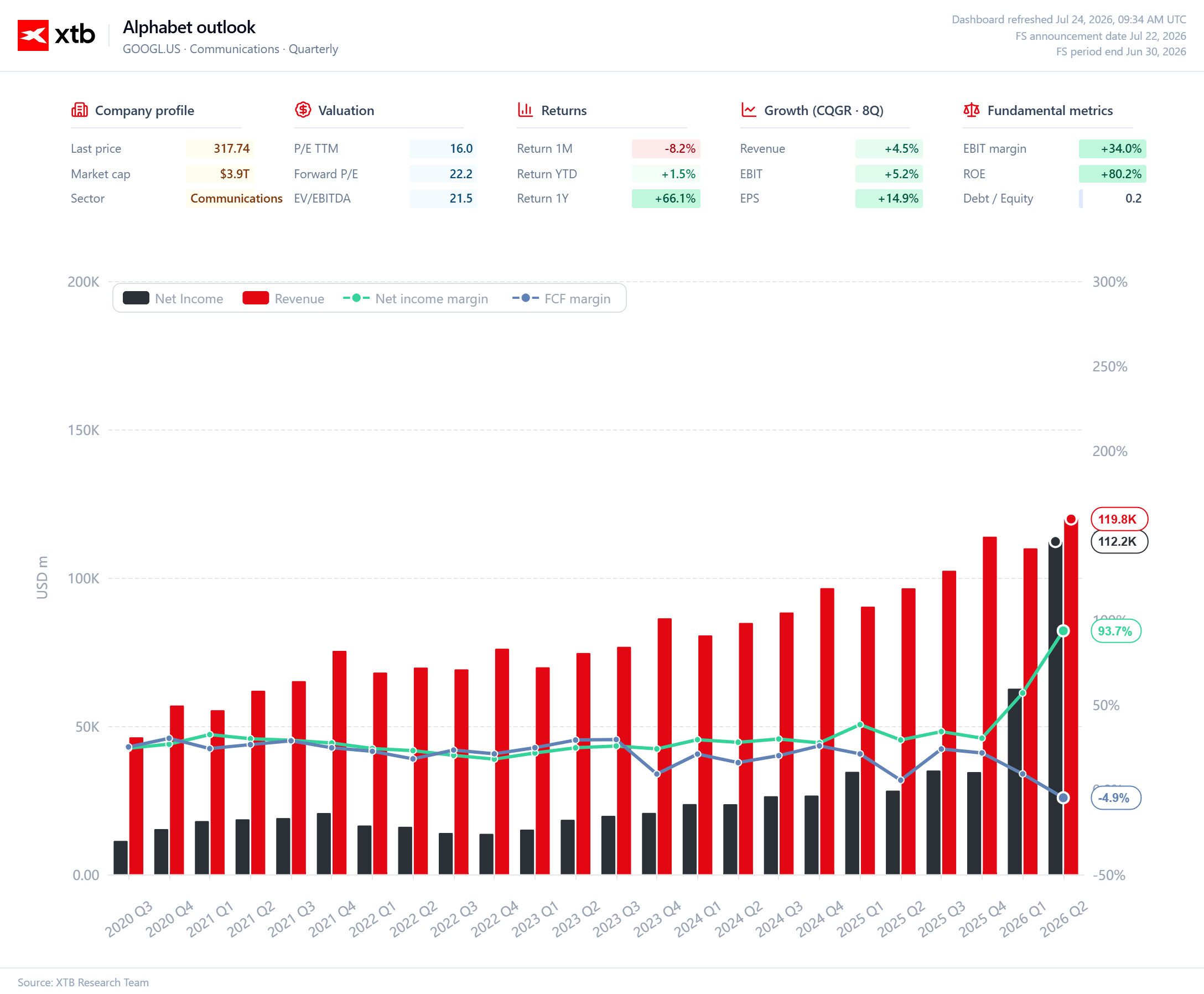
Revenue, net income, net margin, and FCF margin
Alphabet increased quarterly revenue to approximately $119.8 billion , maintaining strong momentum in its core business. Net income, however, climbed to roughly $112.2 billion , a figure that does not solely reflect the company’s operating performance. The unusually high profit was largely driven by a one-time gain from the revaluation of marketable securities . As a result, the reported 93.7% net margin is temporarily inflated and should not be viewed as a sustainable level of profitability. Investors should instead focus on advertising revenue, Google Cloud performance, and operating margins when assessing the quality of earnings. Meanwhile, the free cash flow margin declined to -4.9% , reflecting the pressure created by record capital expenditures. Alphabet continues to allocate increasing amounts of capital to data centers, servers, and AI infrastructure. Negative free cash flow therefore does not necessarily indicate deterioration in the underlying business but rather highlights the growing cost of competing in the AI race. The key question is whether these investments will translate into durable revenue growth and higher productivity over time. Investors should therefore distinguish between one-off financial gains and the company’s recurring operating profitability.
Source: XTB Research Team
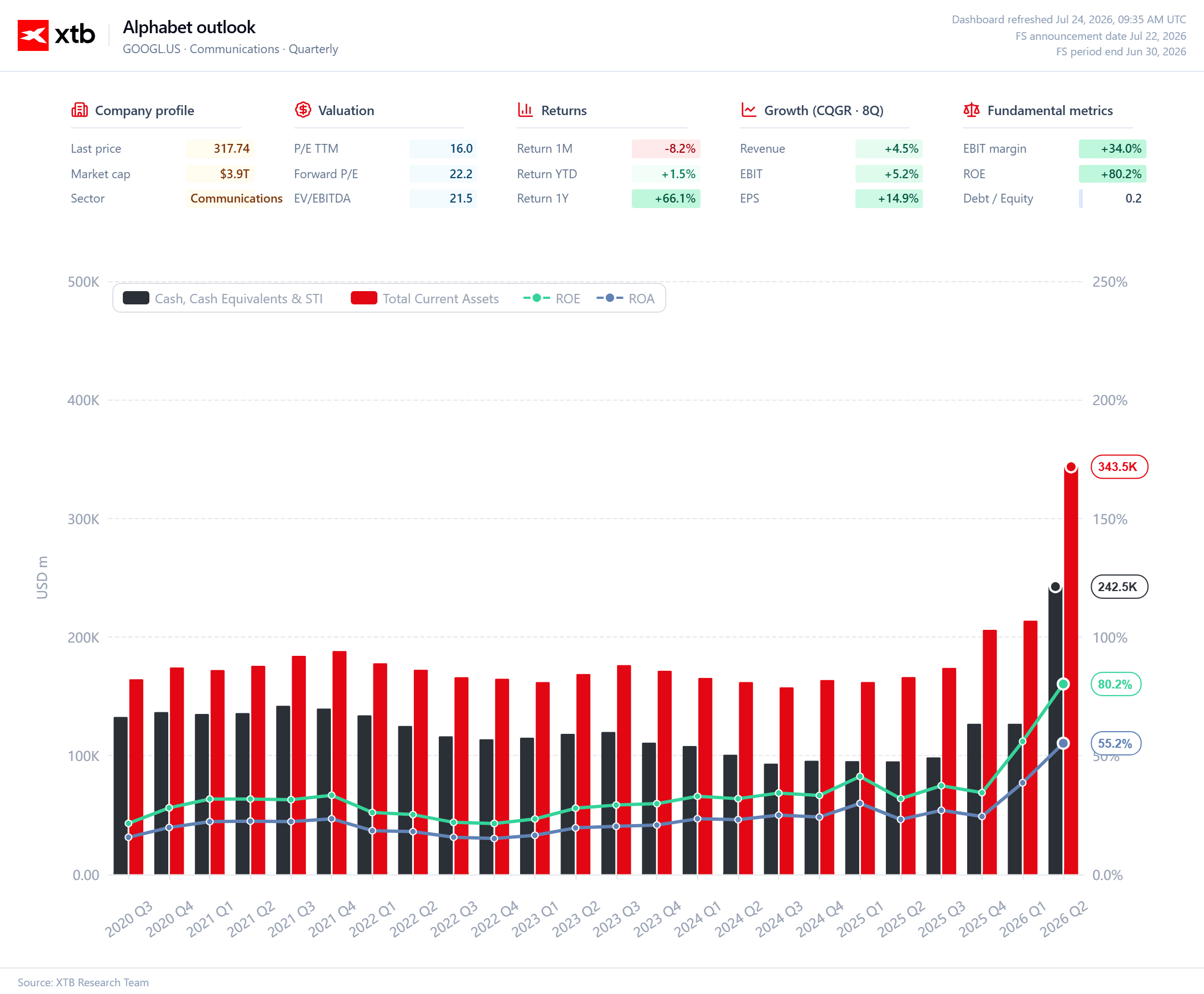
Cash, current assets, ROE, and ROA
Alphabet holds approximately $242.5 billion in cash, cash equivalents, and short-term investments. Total current assets have increased to around $343.5 billion , providing the company with exceptional financial flexibility. This substantial liquidity enables Alphabet to fund massive AI investments without becoming heavily dependent on debt financing. Return on Equity rose to 80.2% , while Return on Assets increased to 55.2% . However, both metrics were materially boosted by the same one-time gain from marketable securities and therefore should not be interpreted as sustainable profitability levels. Even after adjusting for this effect, Alphabet’s underlying capital efficiency remains very strong thanks to its dominant position in digital advertising and the rapid expansion of Google Cloud. Its robust balance sheet significantly reduces the financial risks associated with record AI-related capital spending while preserving flexibility for share buybacks, acquisitions, and future investments. From a fundamental perspective, Alphabet’s liquidity remains one of its strongest competitive advantages, although investors should adjust ROE and ROA for the impact of non-recurring financial gains.
Source: XTB Research Team
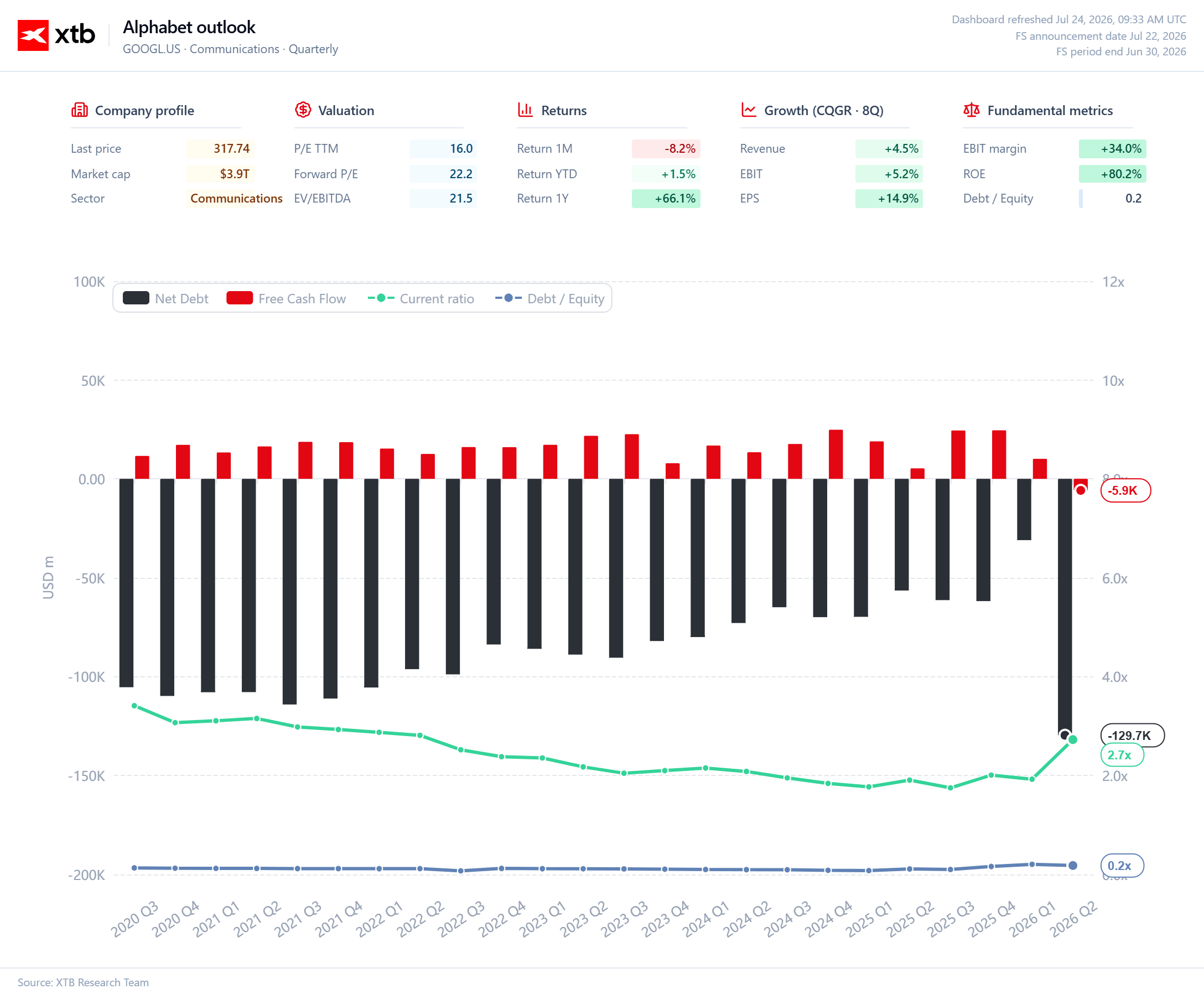
Net debt, Free Cash Flow, current ratio, and Debt-to-Equity
Alphabet maintains approximately $129.7 billion in net cash , meaning its cash holdings substantially exceed total debt. The company’s Debt-to-Equity ratio of just 0.2x reflects an exceptionally conservative capital structure. A current ratio of 2.7x indicates that current assets comfortably exceed short-term liabilities, leaving the balance sheet in a very strong position despite record investment spending. The most notable area of concern is the decline in free cash flow to approximately -$5.9 billion , driven primarily by sharply higher spending on data centers, AI chips, and computing infrastructure. Importantly, negative free cash flow is not the result of liquidity constraints, as Alphabet continues to hold enormous financial reserves. Instead, it reflects management’s strategic decision to accelerate investment ahead of expected long-term demand. Investors will increasingly focus on whether these multibillion-dollar AI investments generate adequate returns over time. If AI services and Google Cloud continue to scale successfully, today’s elevated capital expenditures could ultimately prove to be one of the company’s most profitable long-term strategic decisions. For now, Alphabet’s exceptionally strong cash position provides ample financial capacity to execute this strategy without compromising the strength of its balance sheet.