S&P 500 — US Large Cap Index
 FTSE 100 — UK Blue Chips
 Euro Stoxx 50 — Eurozone Leaders
 DAX 40 — German Equities
 CAC 40 — French Market Index
 Nikkei 225 — Japan Benchmark
 Hang Seng — Hong Kong Index
 Shanghai Composite — China Mainland
 ASX 200 — Australian Market
 TSX Composite — Canada Index
 Nifty 50 — India Large Cap
 STI Index — Singapore Market
 KOSPI — South Korea Index
 Bovespa — Brazil Equities
 JSE Top 40 — South Africa Index
 IPC Index — Mexico Market
EUR/USD Forecast: Euro Faces Fresh Downside Risk as Hawkish Fed Signals Boost Dollar and 1.1445 Support Comes Under Pressure


EUR/USD traded higher toward 1.1475 during Tuesday’s early European session as the euro gained modest ground against the US dollar amid improved risk sentiment and renewed hopes for potential US-Iran diplomatic talks.
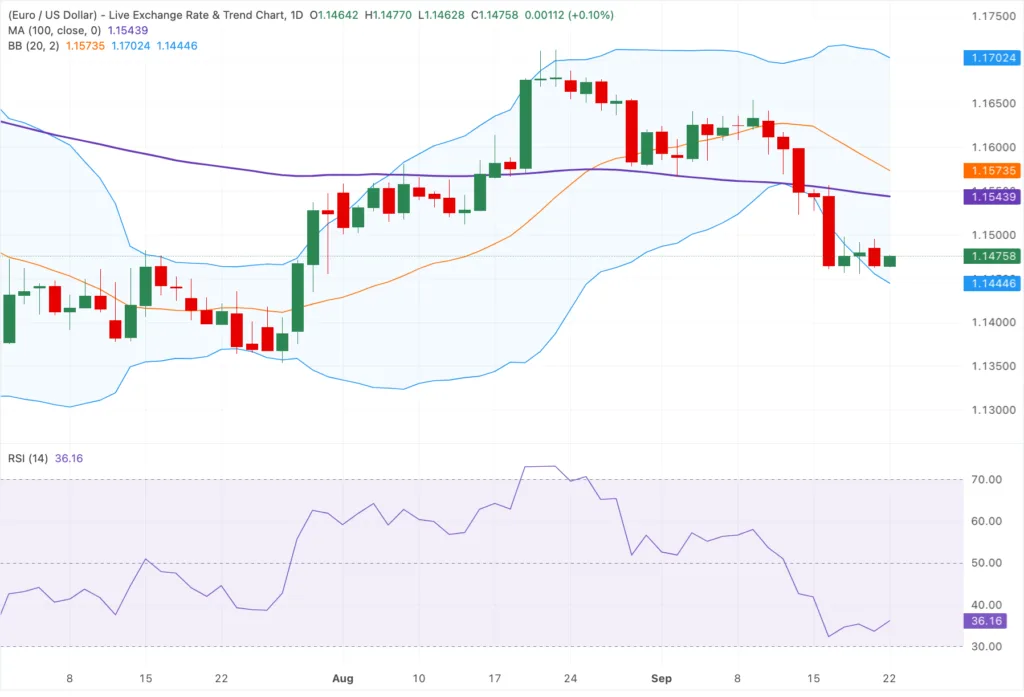
Despite the rebound, the broader technical structure remains under pressure. EUR/USD continues to trade below its 100-day simple moving average (SMA), while the daily Relative Strength Index (RSI) remains in bearish territory. This leaves the pair vulnerable to renewed selling pressure unless buyers can reclaim the key resistance zone around 1.1545.
The dollar is also receiving support from increasingly hawkish Federal Reserve commentary. St. Louis Fed President Alberto Musalem indicated that interest rates may need to rise further to prevent inflation from remaining substantially above the Federal Reserve’s 2% target.
Meanwhile, political developments in Germany are creating an additional source of uncertainty for the euro. Rising political tensions and concerns surrounding European fiscal developments could weigh on confidence in the shared currency in the near term.
EUR/USD Market Snapshot
| Market Factor | Current Situation |
|---|---|
| EUR/USD | Around 1.1475 |
| Short-Term Direction | Rebound, but technically bearish |
| Immediate Support | 1.1445 |
| Secondary Support | 1.1378 |
| Further Support | 1.1353 |
| Initial Resistance | 1.1545 |
| Secondary Resistance | 1.1575 |
| Major Resistance | 1.1654 |
| Technical Indicator | RSI 36, bearish momentum |
| Key Moving Average | 100-day SMA at 1.1545 |
| Main Dollar Driver | Hawkish Fed expectations |
| Main Euro Risk | German political and fiscal uncertainty |
EUR/USD Prices Today: Euro Recovers Toward 1.1475
EUR/USD gained traction around 1.1475 during the early European session, recovering some ground as broader risk sentiment improved.
The move higher has been linked partly to hopes that diplomatic discussions between the United States and Iran could progress during the United Nations General Assembly this week.
However, the rebound has not yet changed the pair’s broader technical structure.
EUR/USD remains below the 100-day SMA at 1.1545, meaning the market continues to face a significant technical barrier above current levels.
US-Iran Talks Improve Risk Sentiment
Potential US-Iran negotiations are currently an important short-term driver for global financial markets.
US President Donald Trump has indicated that he would be open to meeting Iranian President Masoud Pezeshkian, who is expected to be in New York for the UN General Assembly.
Any progress toward diplomatic discussions could reduce immediate geopolitical risk premiums and improve broader risk appetite.
For EUR/USD, however, the impact is not necessarily one-directional. Improved risk sentiment can reduce demand for the US dollar as a traditional safe-haven currency, supporting the euro, but a reduction in geopolitical risk can also encourage capital flows into higher-risk assets.
The market will therefore focus on whether diplomatic developments produce a sustained change in global risk positioning.
German Political Risks Challenge Euro Confidence
Political developments in Germany are adding another layer of uncertainty for the euro.
The Alternative for Germany took first place in a state election in northeastern Germany, while Chancellor Friedrich Merz’s conservative CDU recorded a significant setback.
Analysts at MUFG have highlighted the potential implications for political confidence and European fiscal developments, arguing that the results could increase internal pressure on the CDU leadership and contribute to weaker confidence in the euro in the near term.
The political situation therefore represents an additional risk factor for EUR/USD, particularly if domestic uncertainty begins to influence expectations surrounding German fiscal policy and wider European economic policy.
Federal Reserve Expectations Support the Dollar
Federal Reserve policy remains one of the most important drivers of the EUR/USD exchange rate.
St. Louis Fed President Alberto Musalem adopted a relatively hawkish stance, arguing that interest rates may need to rise further to prevent inflation from remaining materially above the Federal Reserve’s 2% target.
The comments reinforce expectations that US monetary policy could remain restrictive for longer.
This is significant for EUR/USD because higher expected US interest rates can increase the yield advantage of dollar-denominated assets over euro-denominated assets.
Unless incoming US inflation and economic data begin to weaken materially, the Federal Reserve’s policy outlook could therefore continue to provide underlying support for the dollar.
Technical Analysis: EUR/USD Remains Bearish Below the 100-Day SMA
The daily technical picture continues to show a negative near-term bias.
EUR/USD is trading below both the 100-day SMA at 1.1545 and the Bollinger middle band, while price remains in the lower half of the Bollinger envelope.
The 14-day RSI stands at 36, indicating that bearish momentum remains dominant, although the indicator has not yet reached deeply oversold territory.
This means sellers retain the technical advantage, but the market is not yet displaying an extreme oversold condition that would necessarily prevent further downside.
EUR/USD Support Levels
The first important support level is located at 1.1445, around the lower Bollinger Band.
A decisive break below this level could expose the July 14 low at 1.1378.
Further selling could then bring the July 28 low at 1.1353 into focus.
These levels become increasingly important if EUR/USD fails to sustain its recovery above 1.1450.
EUR/USD Resistance Levels
On the upside, the first major barrier is the 100-day SMA at 1.1545.
A sustained move above this level could weaken the immediate bearish technical structure and bring the Bollinger middle band around 1.1575 into focus.
Further gains could expose the September 9 high at 1.1654, followed by the Bollinger upper band around 1.1700.
For the bullish scenario to strengthen materially, buyers would therefore need to reclaim the 100-day SMA and demonstrate follow-through above the subsequent resistance levels.
Bullish Sentiment
1. EUR/USD Holds Above 1.1450
The pair has managed to remain above the immediate 1.1445 support area, allowing buyers to maintain a short-term recovery attempt.
2. Improved Risk Sentiment
Hopes for US-Iran diplomatic discussions have reduced some immediate geopolitical risk concerns, potentially limiting demand for the US dollar as a safe-haven asset.
3. Potentially Lower US Rate Expectations
If future economic data show a meaningful moderation in US inflation or growth, expectations for additional Federal Reserve tightening could weaken, reducing support for the dollar.
4. Break Above 1.1545 Could Improve Technical Structure
A sustained move above the 100-day SMA at 1.1545 would remove an important technical barrier and could open the way toward 1.1575 and 1.1654.
5. Dollar Positioning Remains Sensitive to Fed Communication
Any shift away from the current hawkish Federal Reserve tone could quickly change the relative interest-rate outlook between the US and euro area.
Bearish Sentiment
1. EUR/USD Remains Below the 100-Day SMA
The pair remains beneath the 1.1545 100-day SMA, leaving the broader near-term technical structure bearish.
2. Bearish RSI Momentum
The 14-day RSI at 36 indicates that selling pressure remains present without yet reaching deeply oversold conditions.
3. Hawkish Federal Reserve Expectations
Musalem’s comments that rates may need to rise further strengthen the dollar’s relative interest-rate advantage.
4. German Political Uncertainty
Political instability and concerns about European fiscal developments could undermine confidence in the euro.
5. Break Below 1.1445 Could Accelerate Selling
A decisive move below 1.1445 would expose the 1.1378 and 1.1353 support levels and potentially reinforce the existing bearish technical structure.
EUR/USD Price Forecast: What Traders Are Watching
The immediate EUR/USD outlook is centred on whether the pair can convert its rebound into a sustained break above the 1.1545 100-day SMA.
Holding above 1.1445 keeps the possibility of a recovery alive, while a move through 1.1545 would shift attention toward 1.1575 and then 1.1654.
Conversely, failure to regain the 100-day SMA could leave sellers in control. A break below 1.1445 would increase downside risk toward 1.1378, followed by 1.1353.
The fundamental outlook will remain heavily influenced by the relative paths of Federal Reserve and European monetary policy, while geopolitical developments could generate additional short-term volatility.
EUR/USD Economic Outlook
The euro faces a combination of political and monetary-policy challenges.
German political developments are particularly relevant because Germany remains the largest economy in the euro area. Increased domestic political uncertainty could influence expectations surrounding fiscal policy and broader European economic confidence.
At the same time, the Federal Reserve’s willingness to consider further rate increases creates a potentially significant interest-rate differential between the United States and the euro area.
This makes upcoming central-bank commentary and economic data particularly important for the currency pair.
EUR/USD Market Outlook for the Coming Sessions
EUR/USD is likely to remain highly sensitive to developments surrounding US-Iran talks, Federal Reserve commentary and European political developments.
The immediate technical battle is between 1.1445 support and 1.1545 resistance.
A break below 1.1445 would strengthen the bearish case and bring 1.1378 and 1.1353 into focus.
A sustained break above 1.1545, meanwhile, would weaken the current bearish technical structure and shift attention toward 1.1575 and 1.1654.
Until either side of this range is convincingly broken, volatility could remain elevated as traders balance geopolitical developments against the Federal Reserve’s increasingly restrictive policy signals.
Currency Hedger View
Currency Hedger monitors EUR/USD as one of the world’s most important currency pairs because movements in the euro and US dollar can materially affect international payments, corporate currency exposure and cross-border investment flows.
The current combination of Federal Reserve policy uncertainty, European political developments and geopolitical risk highlights the importance of actively monitoring exchange-rate exposure rather than relying solely on spot-market movements.
Currency Hedger provides managed FX services for business and personal clients, helping clients manage international currency requirements and navigate changing foreign-exchange conditions.
Today Markets View
EUR/USD has recovered toward 1.1475, but the broader technical structure remains bearish while the pair trades below the 100-day SMA at 1.1545.
The immediate levels to watch are 1.1445 on the downside and 1.1545 on the upside. A break below support could expose 1.1378 and 1.1353, while a sustained move above the 100-day SMA could open the way toward 1.1575 and 1.1654.
Fundamentally, the euro is facing political uncertainty in Germany while hawkish Federal Reserve commentary is providing support for the US dollar.
The coming sessions will therefore be driven by the interaction between Fed rate expectations, German political developments, US-Iran diplomacy and the key EUR/USD technical levels.
Louis Roche, Analyst, Today Markets