S&P 500 — US Large Cap Index
 FTSE 100 — UK Blue Chips
 Euro Stoxx 50 — Eurozone Leaders
 DAX 40 — German Equities
 CAC 40 — French Market Index
 Nikkei 225 — Japan Benchmark
 Hang Seng — Hong Kong Index
 Shanghai Composite — China Mainland
 ASX 200 — Australian Market
 TSX Composite — Canada Index
 Nifty 50 — India Large Cap
 STI Index — Singapore Market
 KOSPI — South Korea Index
 Bovespa — Brazil Equities
 JSE Top 40 — South Africa Index
 IPC Index — Mexico Market
European indices under pressure from a stronger dollar. Quantum stocks Gain, IONQ jumps 12%


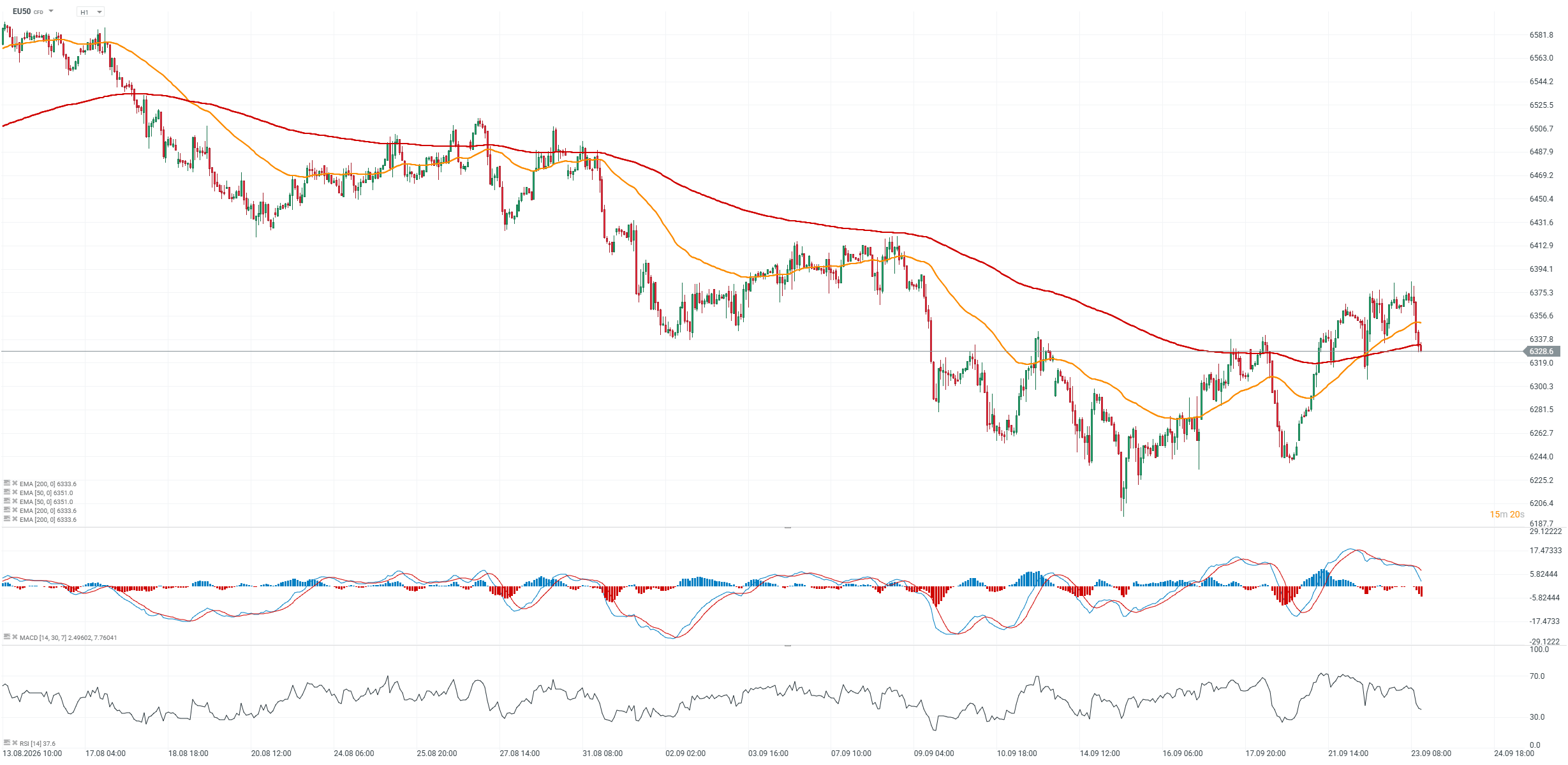
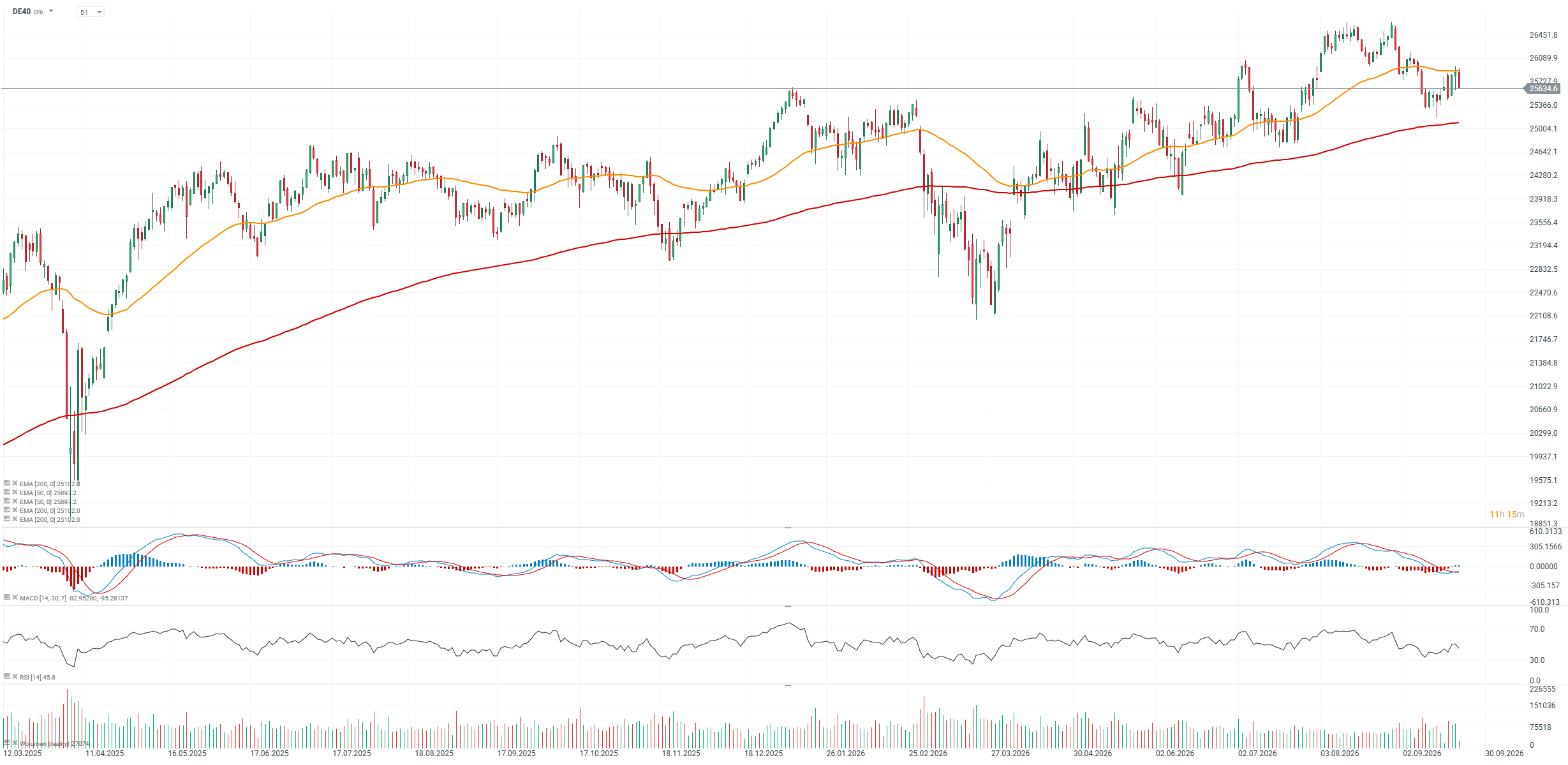
European indices started Wednesday’s session with modest gains, supported by lower oil prices and stronger-than-expected eurozone PMI data, but a strengthening U.S. dollar ultimately weighed on sentiment. The initial optimism did not last long: around 10:00 a.m., indices began to move lower, and most major benchmarks across the continent are now trading in negative territory. Germany’s DAX is down around 0.4%, while the Euro Stoxx 50 is losing roughly 0.2%, suggesting that investors remain cautious despite stronger economic data and the pullback in energy prices.
Key information
- European indices opened higher, but sentiment began to deteriorate around 10:00 a.m. Most major benchmarks are now trading lower, with the DAX down around 0.4% and the Euro Stoxx 50 losing approximately 0.2%.
- Eurozone PMI data came in stronger than expected. Business activity accelerated at its fastest pace in more than three years, although companies also reported a faster increase in operating costs.
- The data are particularly important following the ECB’s recent rate hikes. On the one hand, they point to the resilience of the European economy in the face of tighter monetary policy; on the other, stronger activity and rising costs could limit the scope for rapid monetary easing.
- Oil prices are falling for a sixth consecutive session and remain below $100 per barrel, supported by expectations of higher supply from the Persian Gulf region following the restart of operations at a key Saudi pipeline. The market nevertheless remains sensitive to the risk of renewed supply disruptions.
- Banks were initially among the strongest sectors, gaining around 0.5%, with positive performance from names including Raiffeisen Bank International and KBC Ancora. Technology stocks also performed strongly, with the sector index reaching its highest level in around four weeks.
- Arcadis is down around 7% after Canada’s WSP Global withdrew its takeover offer for the Dutch consultancy and engineering company.
- KWS is falling around 8% after reporting weaker sales. Annual revenue at the German seed producer declined by 3% to EUR1.63 billion, below the consensus estimate of around EUR1.68 billion, partly due to lower sugar beet and corn acreage.
- Adyen is down around 2.5% after announcing that Klarna’s Niclas Neglen will become the company’s CFO effective February 1, 2027.
- Investors are also awaiting a meeting between Donald Trump and Xi Jinping, which will be closely watched for signals on the future of U.S.-China trade relations. Treasury Secretary Scott Bessent has also indicated that talks could include cooperation on AI safety.
- U.S. quantum computing stocks surged in pre-market trading, led by IonQ, whose shares rose around 12% following a breakthrough in real-time quantum error correction.
EU50 chart (H1 timeframe)
Source: xStation5
DE40 chart (D1 timeframe)
Source: xStation5
IonQ shares rise 12% after quantum error correction test
IonQ (IONQ.US) shares are up around 12% in pre-market trading today after the company announced the development and testing of a real-time quantum error correction system running on a single standard CPU. Investors reacted positively primarily to the scale of the tests and the potential significance of the technology for the further development of fault-tolerant quantum computers. The rally in IONQ also lifted other companies associated with the quantum computing sector, including D-Wave Quantum and Rigetti Computing.
IonQ tests decoder across hundreds of logical qubits
Quantum error correction remains one of the key challenges facing the entire sector. Qubits are highly sensitive to noise and interference, meaning that practical quantum computing requires errors to be detected and corrected quickly without significantly slowing calculations. IonQ said its dual-decoder architecture was tested on circuits simulating as many as 408 logical qubits and more than 31.5 million quantum operations. According to the company, the processing overhead amounted to just 0.02%. It is also significant that the system operated on a single standard CPU. According to IonQ, this could simplify the infrastructure required to scale quantum computers and reduce delays associated with the classical hardware responsible for decoding errors.
Technology supports IonQ’s long-term development roadmap
The company said the results also validate assumptions behind its proprietary Walking Cat architecture, which is intended to form part of systems capable of controlling thousands of qubits in the future. For investors, this matters because valuations in the quantum computing sector increasingly depend not only on the number of physical qubits, but also on the quality of logical qubits, error rates and the ability to perform long and complex computations.
IonQ also expands its commercial presence in Asia
Another positive catalyst was the announcement of a multi-year partnership with South Korea’s SDT. Under the agreement, IonQ is expected to deliver a Superion 256 quantum computer, strengthening its presence in the Asia-Pacific region. The financial terms of the agreement were not disclosed. However, the rise in the share price suggests that the market is currently pricing in both IonQ’s technological progress and the possibility of gradually transforming quantum computing research into a viable commercial business.
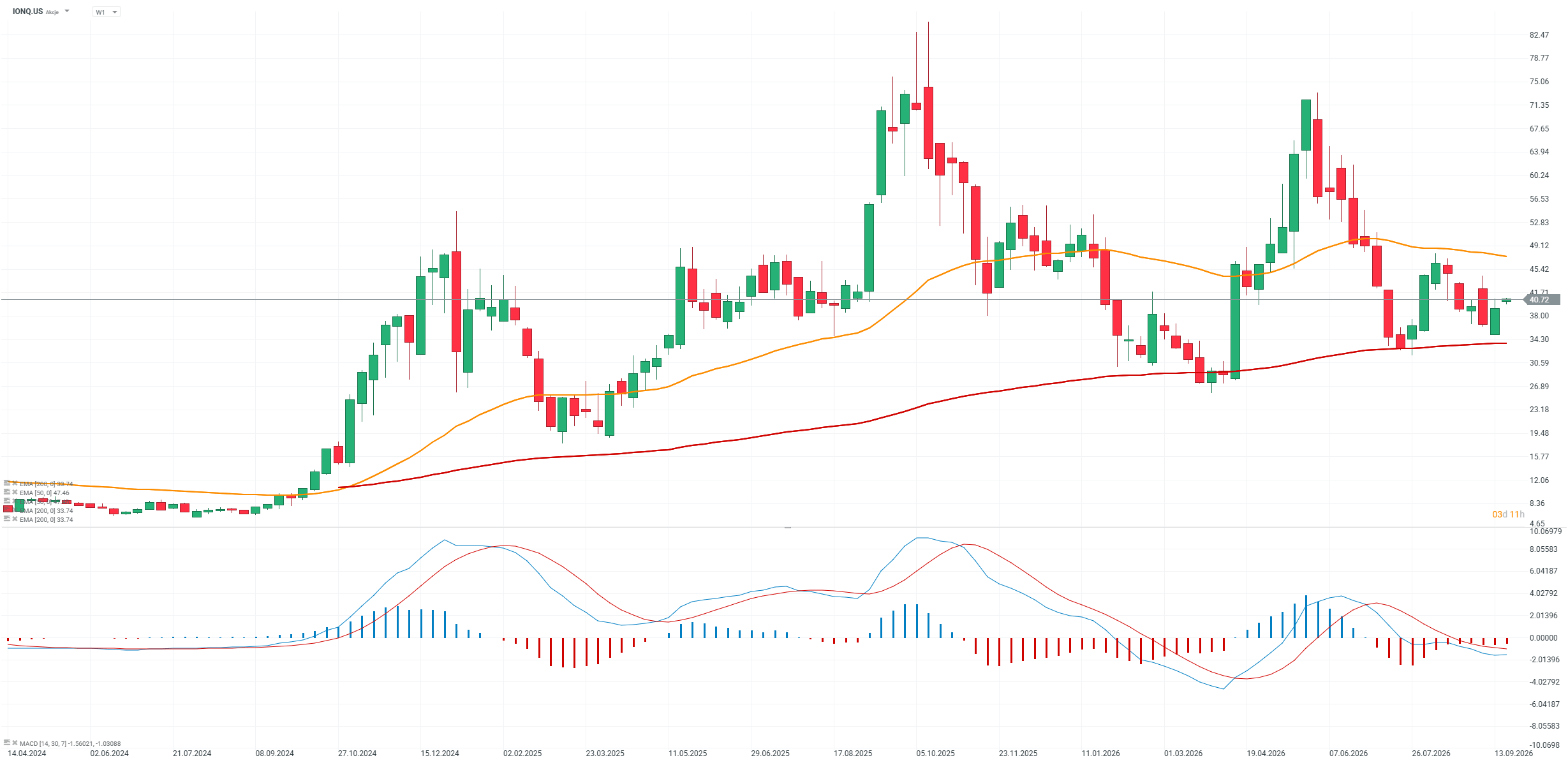
IONQ shares chart (W1 timeframe)
IONQ shares are up more than 12% today, suggesting that the stock could open above its 50-week exponential moving average, EMA50 (orange line), and potentially defend its long-term upward trend. A major challenge for the company remains achieving profitability before 2030. At present, very high research and development (R&D) and acquisition costs mean that net income remains negative, making the company more sensitive to potential changes in U.S. interest rates. This time, however, the company’s technological “breakthrough” is effectively helping to offset concerns about the future condition of the business.
Source: xStation5