S&P 500 — US Large Cap Index
 FTSE 100 — UK Blue Chips
 Euro Stoxx 50 — Eurozone Leaders
 DAX 40 — German Equities
 CAC 40 — French Market Index
 Nikkei 225 — Japan Benchmark
 Hang Seng — Hong Kong Index
 Shanghai Composite — China Mainland
 ASX 200 — Australian Market
 TSX Composite — Canada Index
 Nifty 50 — India Large Cap
 STI Index — Singapore Market
 KOSPI — South Korea Index
 Bovespa — Brazil Equities
 JSE Top 40 — South Africa Index
 IPC Index — Mexico Market

Tesla was supposed to burn $5 billion, but posted a positive result. Will Tesla still be a car company in a year?


Key takeaways
- Tesla posted positive free cash flow of 1.53 billion USD in Q3 2026.
- Automotive gross margin excluding regulatory credits reached 18.1 percent.
- Elon Musk confirmed that a merger between Tesla and SpaceX is under consideration.
Wall Street was preparing for a quarter in which Tesla would throw billions more into the AI furnace. Instead, the company showed positive free cash flow ($1.53 billion), significantly higher automotive margins, and better-than-expected deliveries. The stock is up about 1.1% in after-hours trading after rising 3.4% during the day. For such a positive surprise, the reaction isn’t huge, but the answer isn’t in the report—it’s in Tuesday’s SpaceX conference. There, Elon Musk admitted that a merger of the two companies is a “good idea,” and both sides have set up special committees. Investors are asking less and less about how much Tesla earns on cars or other business activities. Instead, they are increasingly asking what Tesla will even be in a year and whether cars will remain its main business.
Key Data (Q3 2026)
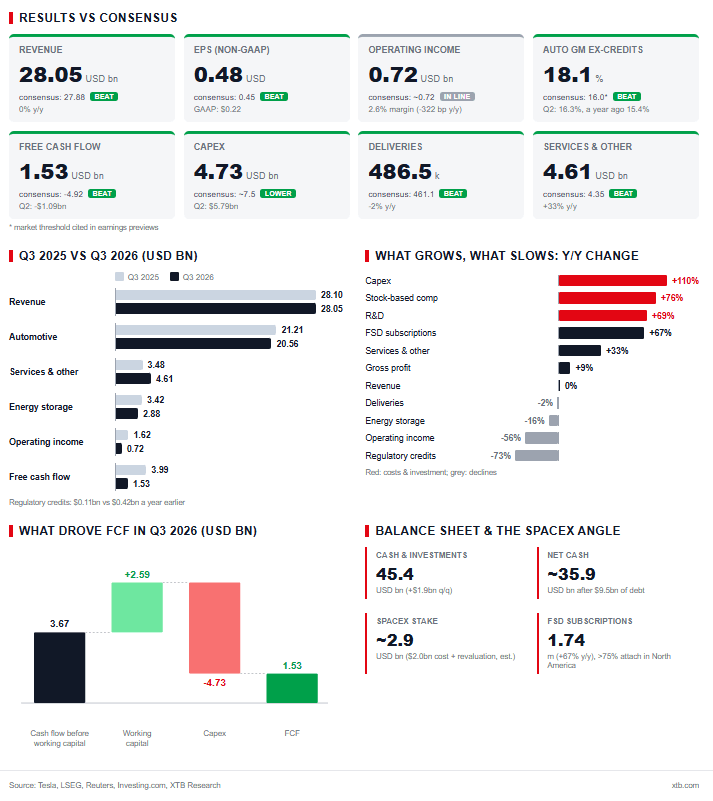
- Revenue: $28.05 billion vs. consensus of $27.88 billion (LSEG). However, this represents virtually flat YoY growth
- Adjusted EPS: $0.48 vs. $0.45 expected; GAAP EPS $0.22 (-44% YoY)
- Operating income: $718 million vs. ~$720 million; operating margin 2.6% (vs. 5.8% a year ago, 1.4% in Q2)
- Automotive gross margin ex-regulatory credits: 18.1% vs. 16.3% in the prior quarter and 15.4% a year ago
- Automotive revenue: $20.56 billion vs. ~$20.2 billion expected (-3% YoY)
- Services and other: $4.61 billion vs. $4.35 billion (+33% YoY)
- Energy storage: $2.88 billion (-16% YoY). Here we see a sizeable negative surprise.
- Capex: $4.73 billion vs. ~$7.5 billion expected ($5.79 billion in Q2)
- Free cash flow (FCF): +$1.53 billion vs. expected -$4.92 billion
- Deliveries: 486.5k vs. 461.1k expected (-2% YoY); production 464.4k
- Active FSD subscriptions: 1.74 million (+67% YoY)
- Cash and short-term investments: $45.4 billion (+$1.9 billion QoQ)
Automotive: The old Tesla holds up better than expectations suggested
For the past few quarters, cars have been the troublesome relative in Tesla’s story. As an auto company, Tesla wasn’t thrilling with its performance, and valuations were out of this world—even more so than SpaceX. However, this quarter rehabilitates that image somewhat. Deliveries beat forecasts by over 25k vehicles. High fuel prices, sales records in Canada, Australia, Japan, and Taiwan, along with record production in Berlin, all helped. Tesla boasts its largest order backlog in four years, citing battery availability rather than demand as its primary constraint. A supply bottleneck is a much nicer problem for a car manufacturer to have than a lack of customers. Margin excluding regulatory credits at 18.1% easily beats not only the 16% threshold that the market viewed as a safe zone, but also the optimistic 17% scenario. Importantly, the margin itself is “cleaner” than a year ago. Regulatory credit revenues fell to $113 million from $417 million, showing that the improvement stems from regional and model mix, FSD sales, and currency exchange rates. However, there is a flip side. Tesla itself admits that the average selling price declined. Concerns that part of the volume, especially in Shanghai, was driven by discounts were not unfounded. Additionally, deliveries exceeded production for the second consecutive quarter by over 22k vehicles, and inventory dropped to 11 days of supply. Without higher production—and that means more batteries—this momentum cannot be sustained for long.
Energy: A weaker quarter, but a stronger storyline
Energy storage revenues fell 16% YoY, partly due to customer refunds related to tariffs. However, gross margin rose to ~33%. Tesla also reported its highest order growth in history and a record backlog. The Megafactory in Texas launched (50 GWh capacity), and the first Megapacks using in-house LFP cells shipped from Nevada. The narrative is simple: data centers need power “right now,” and energy storage is the fastest way to deliver it. This is a segment that could carry far more weight in an AI-driven world than current revenue figures suggest. On the other hand, it remains a small portion of the company’s overall revenue.
Services, FSD, and Robotaxi: Counting miles, not dollars
Services and other were the brightest spot on the income statement. Revenue grew 33% YoY, and record gross profit reached $734 million with a 15.9% margin. FSD subscriptions grew to 1.74 million. In North America, over 75% of new cars leave the lot with FSD—nearly 20 percentage points higher than the previous quarter. The system is now active across nine EU countries. Robotaxi remains primarily a story measured in miles. Cumulative unsupervised mileage approached 2 million miles, an eightfold increase from the prior quarter. Since September 3, Cybercabs have been giving rides to passengers in Austin. But there is one minor, uncomfortable detail: Tesla doesn’t disclose how much revenue this service generates. For now, investors are getting mile counters rather than an income statement. At the same time, this is still just the beginning of the journey.
Other important metrics: Where did the cash come from?
Here it is worth slowing down a bit on the results overview. Positive FCF was the report’s biggest surprise, but its quality is open to debate. Out of $6.26 billion in operating cash flow, about $2.6 billion came from working capital changes:
- accounts payable to suppliers increased by $4 billion;
- deferred revenue increased by $1.3 billion;
- days payable outstanding extended from 58 to 66 days.
Without this effect, FCF would have been around -$1.1 billion, roughly the same as in Q2. Tesla is simply paying suppliers more slowly and spending less than the market expected: $4.73 billion in capex compared to $5.79 billion in the previous quarter, totaling $13 billion year-to-date. Operating expenses are growing rapidly: up 39% YoY to $4.78 billion. R&D spending surged 69%, while stock-based compensation jumped 76%, partly due to Musk’s 2025 incentive plan. These factors cut operating income by 56%. The balance sheet remains a fortress: $45.4 billion in cash and investments against ~$9.5 billion in debt leaves net cash at around $36 billion. At a market cap of ~$1.4 trillion, Tesla trades at roughly 425x trailing 12-month GAAP earnings and ~225x adjusted earnings. With an operating margin of 2.6%, investors are paying for the future, not the present. If this company were evaluated purely as an automaker, everyone would have turned away long ago. But nobody treats Tesla that way.
The elephant in the room, or is it a rocket? The SpaceX merger
On Tuesday, during SpaceX’s earnings conference, Musk stated that combining with Tesla is a “good idea” with “many benefits.” Both companies have established special committees. Musk, who leads both firms, sits on neither committee and cautions that a transaction is not guaranteed. He cited several areas of synergy:
- “superintelligence” software;
- chip design and Terafab;
- robotics;
- launching payloads into orbit for the Starmind constellation;
- connectivity.
The boundaries between the companies are already blurred today. Tesla is a SpaceX shareholder: in Q1 2026, it acquired a $2 billion stake, which after revaluations is worth ~$2.9 billion (based on report estimates). The new Roadster introduced a week ago features limited flight capability thanks to compressed gas technology derived from SpaceX rockets. Cybercab runs on Grok. Why might this make sense for Tesla shareholders?
- Costly AI projects (compute power, chip fabrication, robotics) could be funded by cash flows from the satellite business.
- Musk would no longer have to split his attention and talent between competing entities.
- Conflict-of-interest concerns that have surfaced for years around transactions within his empire would be eliminated.
It is also worth asking a question that naturally comes to mind: is lower-than-expected capex a coincidence, or an early sign that part of the AI infrastructure might eventually be folded into a shared project? It remains a hypothesis for now, but the timing is telling. Why caution is warranted?
- Exchange ratio: Two companies with heavy growth valuations would be merging, with Musk sitting on both sides of the table. Whether minority shareholders get a fair valuation will depend on the independent committees.
- Transparency: Tesla would transform into a complex conglomerate spanning cars, energy, robots, rockets, and satellites. Evaluating any single segment on a standalone basis would become even harder.
- Geopolitics: Combining a Shanghai factory producing over 950k vehicles a year under the same umbrella as a key US defense contractor is a setup regulators will scrutinize very closely.
- Incentive package: Musk’s 2025 performance milestones (deliveries, FSD subscriptions, robotaxis) are strictly tied to Tesla. A merger would raise questions about how to evaluate them.
The market reaction itself is interesting. On Wednesday, SpaceX shares gained 7.8%, while Tesla rose 3.4%. This could signal that investors currently see more immediate upside for SpaceX in a potential deal.
Summary
Tesla gave skeptics solid numbers—stronger than many expected: good automotive margins, positive cash flow, and better delivery figures. Beneath the surface, the picture is less rosy. Cash flow was largely driven by working capital adjustments, costs are growing nearly 40% annually, and a 2.6% operating margin resembles a mediocre legacy automaker rather than a $1.4 trillion AI leader. The market seems to have understood this for a while, explaining the muted reaction. On the other hand, the question is how long the market can trade on future expectations, and just how far into the future those expectations reach. The most significant shift this quarter isn’t in the tables. For years, investors bought Tesla as a call option on autonomy and robotics. Now, it is increasingly bought as a piece of Musk’s broader empire, where the lines between cars, rockets, and AI chatbots are blurring. Whether that is good news for Tesla shareholders hinges on a single unknown number: the exchange ratio.
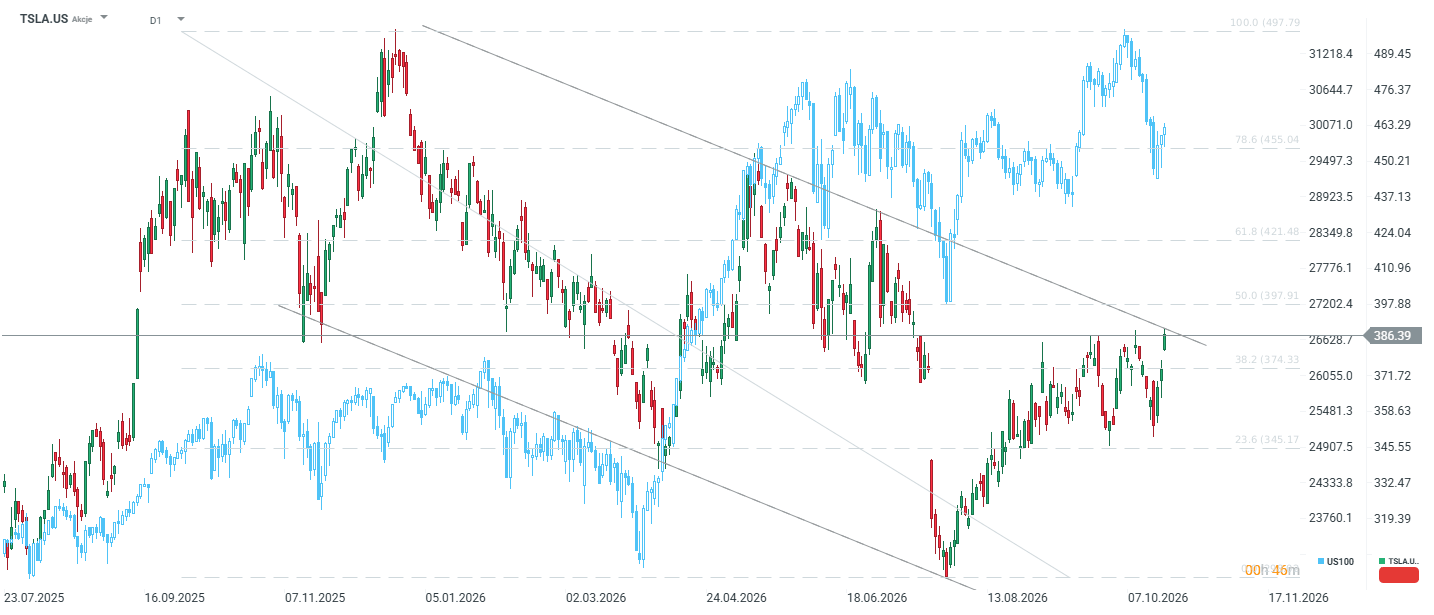
Tesla is about 30% below its all-time high and simultaneously 30% above its local low from July. If the stock closes above the upper boundary of the downtrend channel tomorrow, it could signal a breakout from the overall trend and a potential move toward the $400 mark.