S&P 500 — US Large Cap Index
 FTSE 100 — UK Blue Chips
 Euro Stoxx 50 — Eurozone Leaders
 DAX 40 — German Equities
 CAC 40 — French Market Index
 Nikkei 225 — Japan Benchmark
 Hang Seng — Hong Kong Index
 Shanghai Composite — China Mainland
 ASX 200 — Australian Market
 TSX Composite — Canada Index
 Nifty 50 — India Large Cap
 STI Index — Singapore Market
 KOSPI — South Korea Index
 Bovespa — Brazil Equities
 JSE Top 40 — South Africa Index
 IPC Index — Mexico Market
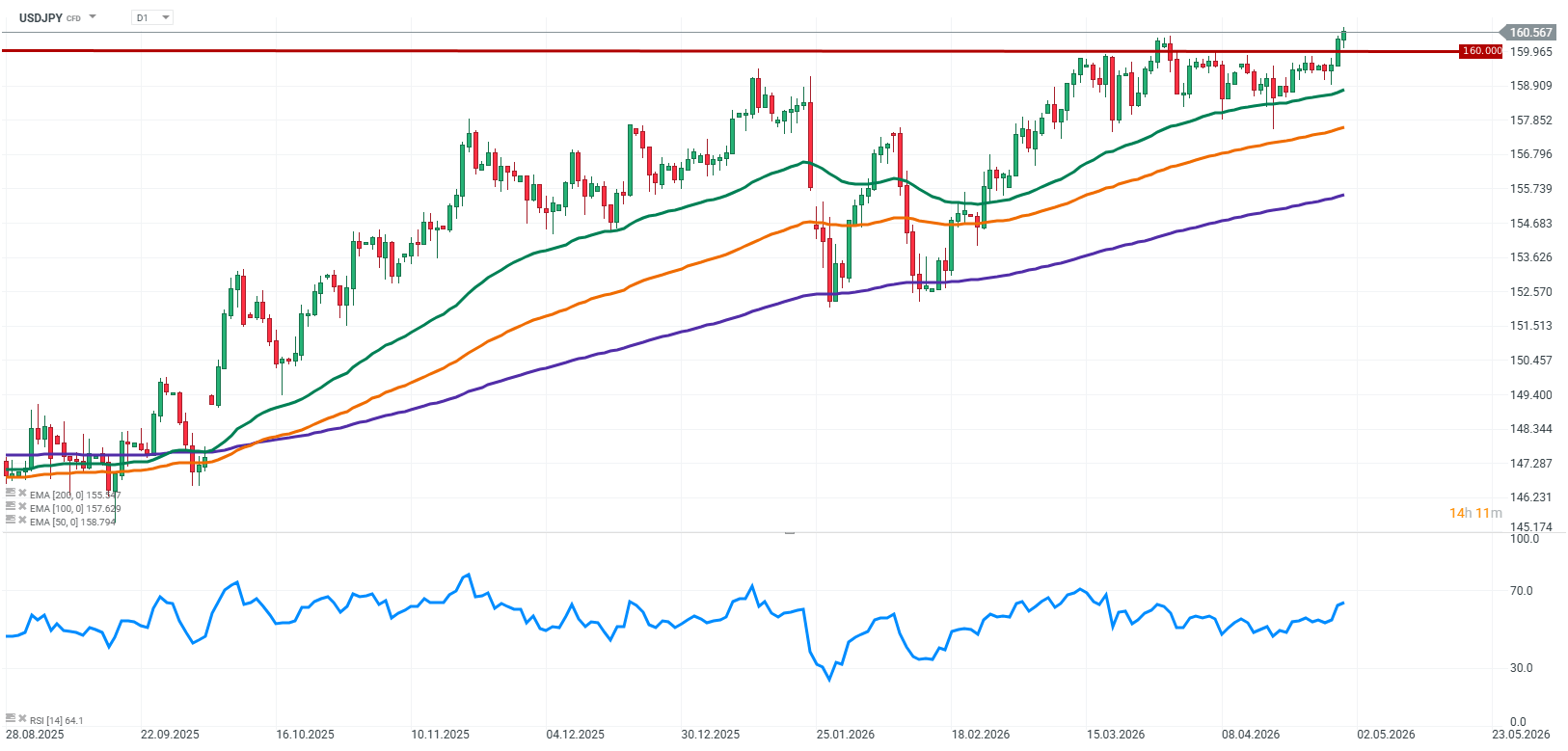
Chart of the Day: Yen breaks beyond 160 as the market tests the limits of the “red line”


USDJPY has decisively broken through the psychological 160 level, reaching new multi-month highs and entering territory that was until recently treated as an informal red line for Japanese authorities. Importantly, the breakout has not been met with any strong verbal pushback from the Ministry of Finance, which the market interprets as a growing tolerance for further yen weakness, at least in the short term. This move is not happening in isolation. It reflects the classic combination of two dominant macro forces: a persistently wide interest rate differential and mounting pressures within Japan’s real economy, which are becoming increasingly difficult to ignore.
Source xStation5
What is driving USDJPY? Fed and BOJ stable rates, diverging narratives
Both the Federal Reserve and the Bank of Japan left interest rates unchanged, which in itself was not a surprise for markets. The key focus, however, was on communication nuances that further widened the divergence between the two economies. The Fed remains relatively hawkish, emphasizing the resilience of the US economy and a lack of urgency to pivot toward rate cuts. As a result, the dollar continues to benefit from higher yields and the sustained attractiveness of carry trade strategies. On the other side, the BOJ remains cautious, trying to balance the end of ultra-loose monetary policy with the risks of tightening too quickly. However, it is becoming increasingly clear that the issue is no longer only imported inflation driven by commodities, but also yen weakness itself, which is now amplifying domestic price pressures.
Japan trapped in a cost and commodities squeeze
Japan’s economic fundamentals are sending increasingly mixed signals. Retail sales suggest some resilience in consumer demand, while industrial production disappointed in March, partly due to supply chain disruptions and rising cost pressures linked to global commodity tensions. Particularly important is the situation around the Strait of Hormuz, which continues to elevate risks for global oil and gas flows. For Japan, a heavily import-dependent energy economy, this translates into higher production costs and a deteriorating trade balance. In this context, reports of a possible return of energy subsidies during the summer highlight the government’s attempt to cushion cost pressures, although such measures appear more like short-term stabilization tools rather than a structural response to persistent yen weakness.
160 as a psychological level and a test of market patience
The break above 160 is not purely a technical move. It represents a direct test of Japan’s tolerance threshold for currency weakness. Historically, these levels have been associated with heightened sensitivity from authorities, yet the lack of immediate reaction is encouraging the market to probe further. At this stage, the balance of forces remains tilted toward fundamentals. A persistently wide US–Japan rate differential continues to support capital flows into the dollar, while weak Japanese industrial data and commodity-driven pressures leave the BOJ with little room to tighten policy aggressively in the near term.
Outlook
The current USDJPY move increasingly resembles a classic carry trade driven environment, where fundamentals and momentum reinforce each other. Unless there is a meaningful shift in BOJ policy or a more forceful intervention from the Ministry of Finance, the path of least resistance remains higher. The key question is no longer whether 160 would be broken, but how long the market will continue testing the absence of intervention and where the true line in the sand ultimately lies.