S&P 500 — US Large Cap Index
 FTSE 100 — UK Blue Chips
 Euro Stoxx 50 — Eurozone Leaders
 DAX 40 — German Equities
 CAC 40 — French Market Index
 Nikkei 225 — Japan Benchmark
 Hang Seng — Hong Kong Index
 Shanghai Composite — China Mainland
 ASX 200 — Australian Market
 TSX Composite — Canada Index
 Nifty 50 — India Large Cap
 STI Index — Singapore Market
 KOSPI — South Korea Index
 Bovespa — Brazil Equities
 JSE Top 40 — South Africa Index
 IPC Index — Mexico Market
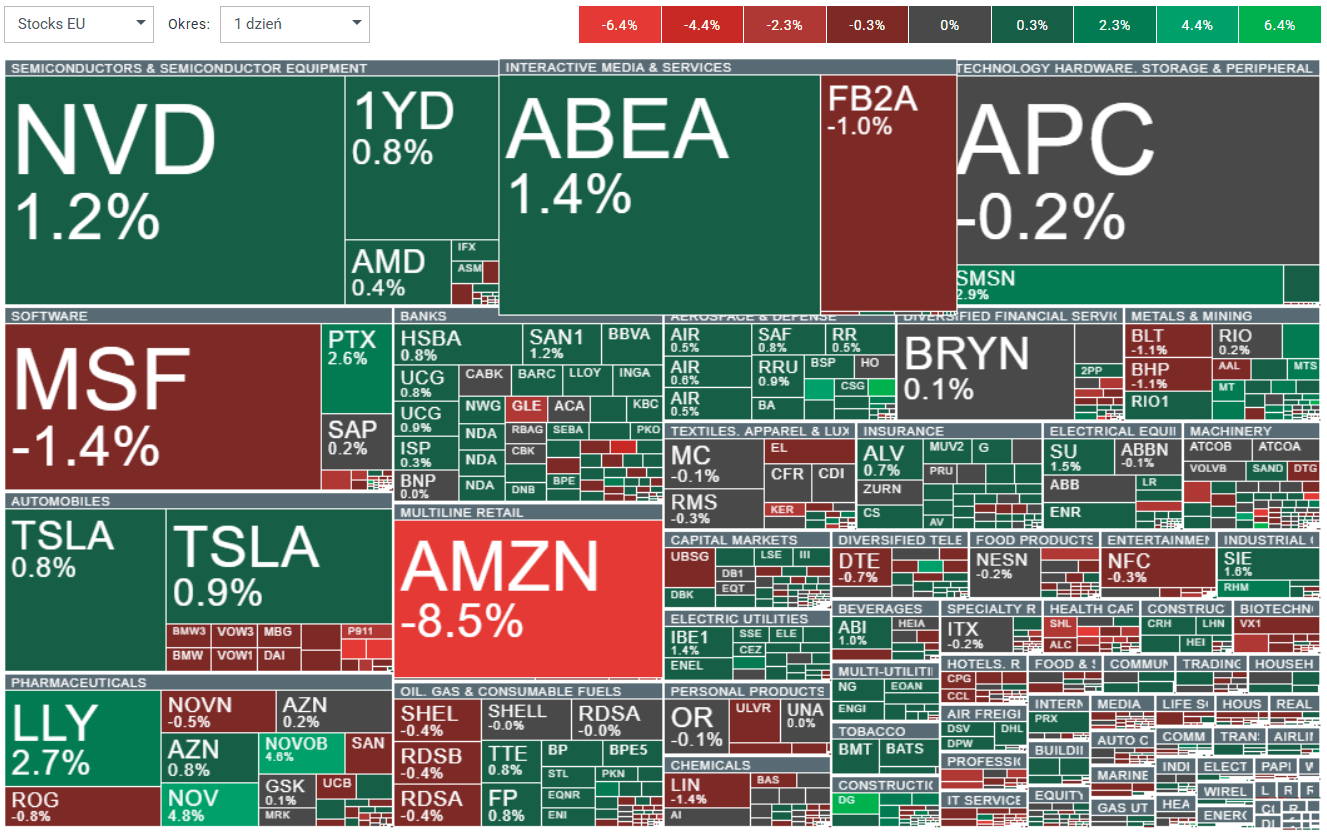
- European stocks and indices started Friday with a mildly positive tone. Futures on the Euro Stoxx 600 are up 0.40%, reflecting a calmer mood after a volatile US session.
- The broader global backdrop remains fragile following a weak close on Wall Street. US equities saw a very sharp selloff on Thursday, and moves across asset classes pointed more to heightened volatility than to a clear risk-on or risk-off environment.
- BNP Paribas noted that quality stocks are no longer expensive and could begin to outperform if economic growth holds up. The bank highlighted that valuations have retraced toward long-term averages.
- The MSCI Europe Quality Index is trading around its long-term average forward P/E, while the Stoxx 600 appears slightly more expensive on that basis. The valuation premium for top-quality companies has fallen to around 20%, close to the lower end of its range over the past 12 years.
- Barclays, however, is cooling enthusiasm around a return of quality stocks as market leaders, arguing that a clear catalyst is still needed. The bank points out that capital positioning in the sector remains elevated while sentiment is weak.
- Barclays also stresses that macro fundamentals continue to favor value stocks. Stabilizing real interest rates, improving macro data, and fiscal stimulus keep the risk-reward profile for value attractive, despite the recent rise in valuations.
- JPMorgan’s models indicate an “early recovery” phase, which typically benefits value stocks, small caps, and higher-risk strategies. The bank believes that easing monetary policy and a weaker dollar will continue to support cyclical stocks at the expense of defensives, with value leading the market.
- German macro data highlighted how difficult it remains to revive industrial momentum. Industrial production fell 1.9% m/m in December, well below expectations.
- Weakness was concentrated in cyclically sensitive segments. Output excluding energy and construction dropped 3.0%, driven mainly by autos (-8.9%) and machinery and equipment (-6.8%). Energy production fell 1.8%, while construction rose 3.0%.
- Despite the weak December print, the quarterly picture still suggested a small positive contribution to growth. Output in Q4 2025 was about 1% above the previous quarter’s average, consistent with GDP growth of roughly 0.3% q/q — with full details due on February 25.
- There were also signs of improving demand that could support a gradual recovery in the second half of 2026. Industrial orders jumped 7.8% in December, the strongest increase in two years, and the Ifo business climate index for manufacturing improved at the start of 2026, although it remains at low levels.
- Bloomberg Economics expects only modest growth in early 2026 before fiscal spending delivers a stronger boost later in the year. Forecasts point to 0.2% GDP growth in Q1 2026 and 0.3% in Q2 2026, with a sharper acceleration in the second half driven by infrastructure and defense investment.
The material on this page does not constitute financial advice and does not take into account your level of understanding, investment objectives, financial situation or any other specific needs. All information provided, including opinions, market research, mathematical results and technical analyzes published on the Website or transmitted To you by other means, it is provided for information purposes only and should in no way be construed as an offer or solicitation for a transaction in any financial instrument, nor should the information provided be construed as advice of a legal or financial nature on which any investment decisions you make should be based exclusively To your level of understanding, investment objectives, financial situation, or other specific needs, any decision to act on the information published on the Website or sent to you by other means is entirely at your own risk if you In doubt or unsure about your understanding of a particular product, instrument, service or transaction, you should seek professional or legal advice before trading. Investing in CFDs carries a high level of risk, as they are leveraged products and have small movements Often the market can result in much larger movements in the value of your investment, and this can work against you or in your favor. Please ensure you fully understand the risks involved, taking into account investments objectives and level of experience, before trading and, if necessary, seek independent advice.