S&P 500 — US Large Cap Index
 FTSE 100 — UK Blue Chips
 Euro Stoxx 50 — Eurozone Leaders
 DAX 40 — German Equities
 CAC 40 — French Market Index
 Nikkei 225 — Japan Benchmark
 Hang Seng — Hong Kong Index
 Shanghai Composite — China Mainland
 ASX 200 — Australian Market
 TSX Composite — Canada Index
 Nifty 50 — India Large Cap
 STI Index — Singapore Market
 KOSPI — South Korea Index
 Bovespa — Brazil Equities
 JSE Top 40 — South Africa Index
 IPC Index — Mexico Market

Key takeaways
- Will the stock market sell off continue?
- US Fed poised to hike this year
- Is the reflation trade back?
- The winners and losers from the reflation trade
- All set for lift off, SpaceX IPO enthusiasm builds even with tech sell off
- Macroeconomic data to the fore
- US inflation preview
- Will it be a one and done rate hike from the ECB?
The Week Ahead: When tech, macroeconomics and geopolitics collide As we start a new week, the market is digesting a large upside surprise in US payrolls, tech stock jitters, a huge week for macroeconomic data and an increasingly fragile ceasefire in the US, after Iran and Israel both attacked each other, which could end the truce which has been in place since April. Oil prices have jumped 4% and Brent crude is back above $97 per barrel.
Will the stock market sell off continue?
As we move into June, the question traders are asking is will the stock market sell off continue? The sharp selloff in stocks at the end of last week saw the Nasdaq lose nearly 5%, its largest daily drop in a year. The S&P 500 also plunged 2.6% on Friday, the index lost 2% on weekly basis, bringing an abrupt end to its 9-week winning streak. The selloff came after US markets made record highs earlier in the week, and was triggered by jitters about AI stock valuations, and a rapid repricing of interest rate expectations for the Federal Reserve, after May’s blowout jobs report. Payrolls rose by 172,000, far exceeding the 85,000 expected. So far on Monday, stock futures are mixed. Asian stocks have fallen sharply, with an 8% drop for the South Korean Kospi. The Nikkei plunged more than 4%. However, there are signs of stabilization in the US, Nasdaq futures are currently pointing to a positive open. The S&P 500 and the Dow Jones are poised to open lower, while the FTSE 100 and Eurostoxx 50 index are also pointing to losses this morning. We expect European and Asian indices to take their cue from the US later today.
US rate hike expectations surge
There is now a 50% chance of a rate hike from the Fed by the end of the year, even though a large increase in jobs was accompanied by cooling annual wage growth from 3.6% to 3.4%. The market is focusing on the job number rather than wage growth, and this has shifted the dial for financial markets. While stocks sold off, US Treasury yields jumped last week. The 2-year Treasury yield rose by 13bps, while the 10-year yield rose 10bps. The sell off in Treasuries spread to other sovereign bonds, with UK and Europe joining in the selloff.
Is the reflation trade back?
There is a key theme developing across financial markets right now, which could dictate price action as we move into the second half of the year: beneath the market volatility the global economy is experiencing an inflation shock, but not a growth shock. This is particularly relevant for the US economy, which is an outperformer in both job creation and GDP. Growth in the US is outpacing China, Europe, the UK and Japan. Eurozone growth dipped into negative territory in Q1, it fell 0.2%, even as the ECB gets ready to hike rates. The question for investors now is, how will stocks hold up when inflation is high, but growth is steady? The market reaction to an inflation shock is very different depending on the outcome for growth. The reflation trade, when growth picks up alongside inflation, is generally positive for stocks, however, stagflation, which the Eurozone is facing, generally leads to a worse outcome for markets. If US growth remains supported, it Is hard to see a prolonged sell off in stocks, and equities are typically resistant to a rise in bond yields if growth manages to keep pace.
The winners and losers from the reflation trade
If we are in a reflation cycle in the US, then expect sector rotation to continue. A high growth, high inflation story can help companies to preserve margin growth and earnings power, which can boost the aggregate index. But underneath there could be big changes going on, and we may have witnessed the start of this on Friday. Energy, materials and financials tend to outperform when inflation and growth rise in unison. However, rising yields depress high growth sectors like tech and consumer discretionary. Real estate stocks also underperform along with utilities. This theme played out in markets at the end of last week, large cap value stocks were the most resilient, falling 1.1%, compared to large cap growth stocks, which slumped nearly 4%. On a sector basis, technology fell more than 6% on Friday, and consumer discretionary fell 2%. In contrast, consumer staples, healthcare and financials all posted a gain on Friday. On a weekly basis, the energy sector rose 2%, financials rose by 1.4% and healthcare was 2.4% higher. Thus, the sell-off is concentrated within the tech sector for now, and the worst performers on Friday include Micron, which slipped 13% and backed away from its $1 trillion valuation, and memory chip maker SanDisk, which dropped by 11%. Even Nvidia slipped 6%, which was a major drag on the S&P 500. In contrast to the sharp selloff in the Nasdaq 100 last week, the FTSE 100 fell 1.7%. It lagged the Nasdaq as the US tech index surged to record highs, it could also outperform as the Nasdaq comes under pressure, as you can see below.
Chart 1: the Nasdaq 100 and the FTSE 100, short term chart
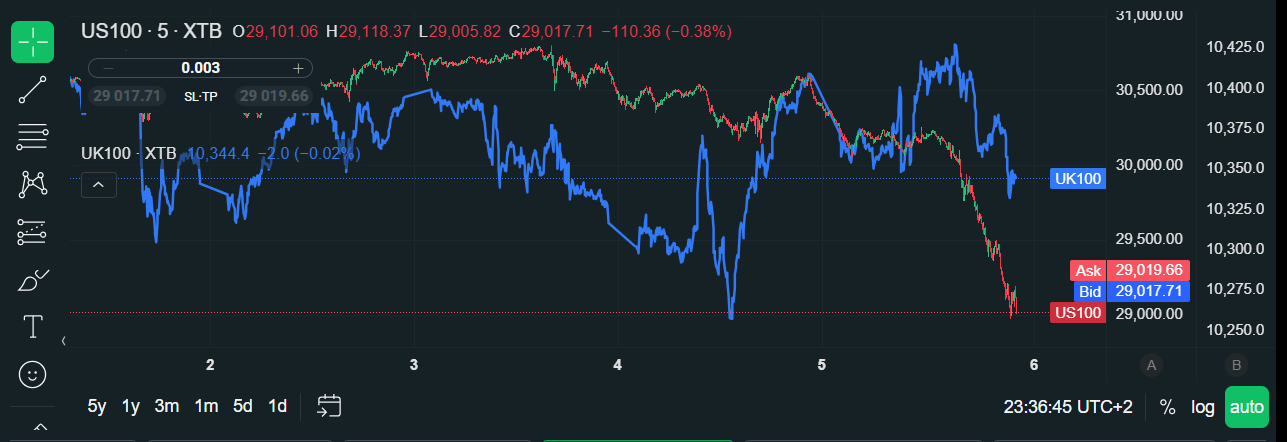
Source: XTB
Although there are plenty of overbought tech stocks in the US right now, Friday’s sell off may not signal the top of the market. A pullback is a typical reaction to a parabolic rally, and it does not always signal a deeper correction. While momentum abruptly stopped on Friday, especially for the tech sector, the downside for tech, including the hyperscalers like Microsoft, Amazon and Alphabet, could be protected due to the expected productivity gains.
All set for lift off, SpaceX IPO enthusiasm builds even with tech sell off
Even with the selloff in tech, we still expect the SpaceX IPO later this week to generate much excitement, which is likely to be closely followed by Anthropic. Although these mega-cap share offerings will be a big test for the market, we expect demand to be strong, at least initially. These mega-cap IPOs suggest a new frontier in stock markets: investors are no longer just buying a business; they are now buying an idea. We will be covering this theme in more detail later this week.
Macroeconomic data to the fore
This is one of the biggest macro weeks of the summer, and the highlight will be US CPI, which is scheduled for release on Wednesday. We expect a slower start to trading today, especially compared to the volatility we experienced on Friday. However, the CPI update on Wednesday should inject volatility back into the market. A hotter than expected CPI release could trigger another sell off in stocks, while a cooler reading could see stocks bounce sharply. The backdrop to the CPI data is one where the oil price is rising again, although crucially the price of Brent remains below $100 per barrel. Comments from the White House suggests that the President would like to keep peace talks on track with Iran, which could limit upside for the price of oil. Combined with news that Opec + will approve its fourth output quota hike since the closure of the Strait of Hormuz, this suggest that the latest flare up in tensions in the Middle East may not see oil returning to the highs from earlier in the war. This is a big week for markets, and it may shape the direction of travel for risky assets for the rest of the summer months. Below, we look at two of the most important macro events for financial markets in the coming days.
1, US inflation preview
US price data will be released on Wednesday, and the market is expecting headline prices to jump to 4.2% in May, from 3.8% in April. Core price growth is expected to rise a notch to 2.9% from 2.8%. Producer price growth could also exceed 6% for last month, which is unlikely to reassure the Fed that they can keep their loosening bias in place for the long term. The outlook for the Fed is complicated once more by President Trump, who heaped pressure on new chair Kevin Warsh to cut rates over the weekend. We will need to wait for next week’s post-FOMC press conference from Warsh before we know if he is listening to the President, or setting policy based on the economic data. Any sign that Warsh is bowing to pressure from the White House could send Treasury yields into a spiral, as it would threaten the Fed’s credibility. There is currently one hike priced in by the Fed for this year, with the hike expected to come in the fourth quarter. However, a hot inflation print could see the interest rate futures market recalibrate this to earlier in the year, as inflation pressure bites. In the unlikely scenario that US CPI is below expectations, we would expect a broad-based global asset price recovery. This week’s data could also trigger volatility in USD/JPY. This pair closed above 160.00 on Friday, which is considered an intervention zone by the BOJ to strengthen the yen. If CPI is stronger than expected, and puts even more upside pressure on the USD, we would expect the BOJ to act, triggering volatility in this pair.
2, The ECB set to hike
This is tricky time to be a central banker. An international energy shock has wreaked havoc with interest rate expectations, and an inflation shock is forcing the ECB to hike rates when growth is floundering. There is now a 99.9% chance of a hike from the ECB this week, and 2 further hikes expected by Q1 2027. At this stage, the bigger shock would be if the ECB did not hike rates. The ECB is facing a situation of slowing growth and rising headline inflation, which leaves them with no choice but to hike rates, since they have one mandate: to protect price stability. Eurozone CPI is now 3.2% YoY, below US rates, but still extremely uncomfortable for most ECB members. Some may ask if the ECB is making a policy mistake? For example, there is little fiscal help for households in the currency bloc to cope with the latest energy price spike, and unlike 2022, growth is weaker, so higher prices cannot easily get passed onto consumers. Added to this, 50% of European prices have low growth rates that are below 1%. Thus, we think this week’s hike will be an insurance hike, designed to take the edge off the energy price spike, which will work its way out of the system once the Strait of Hormuz reopens. The ECB is unlikely to signal that this will be a ‘one and done’ hike, and instead Christine Lagarde may avoid committing to any further hikes, although her tone could be mildly hawkish. This may support the euro, which fell to $1.15 vs the USD on Friday, and dropped 1% last week.