S&P 500 — US Large Cap Index
 FTSE 100 — UK Blue Chips
 Euro Stoxx 50 — Eurozone Leaders
 DAX 40 — German Equities
 CAC 40 — French Market Index
 Nikkei 225 — Japan Benchmark
 Hang Seng — Hong Kong Index
 Shanghai Composite — China Mainland
 ASX 200 — Australian Market
 TSX Composite — Canada Index
 Nifty 50 — India Large Cap
 STI Index — Singapore Market
 KOSPI — South Korea Index
 Bovespa — Brazil Equities
 JSE Top 40 — South Africa Index
 IPC Index — Mexico Market

Facts
- According to the latest USDA report, the condition of the U.S. winter wheat crop is the worst since 2006.
- USDA projects U.S. wheat ending stocks for the 2026/27 season at 762 million bushels , representing an 18% year-over-year decline compared to the 2025/26 season.
- Approximately 20% of the U.S. winter wheat crop is rated very poor , while another 26% is rated poor . Around 29% of the crop is classified as fair , only 21% as good , and just 4% has received the highest excellent rating.
- Winter wheat conditions have deteriorated steadily throughout the growing season, with the downtrend persisting since the first USDA Crop Progress report was released on April 6.
- The WHEAT contract has recently started to rebound after its RSI dropped to around 32 on June 8, approaching technically oversold territory.
Recommendation Long position on WHEAT at market price
- Take Profit: 644
- Stop Loss: 567
Opinion Wheat futures have rebounded from recent lows, while market fundamentals are increasingly supporting a bullish outlook. The latest USDA data showed that U.S. winter wheat conditions have deteriorated to their weakest level since 2006. As much as 46% of the crop is rated poor or very poor , while only 4% is rated excellent. Conditions remain particularly challenging across key producing states such as Kansas, Oklahoma, Texas, and Nebraska, where the effects of a prolonged drought remain visible despite recent improvements in weather conditions. At the same time, USDA forecasts U.S. winter wheat production to fall to its lowest level since the 1965/66 season , while total U.S. wheat output is projected to decline to its lowest level since 1972/73 . Ending stocks for the 2026/27 season are expected to fall to 762 million bushels , down 18% year-over-year and marking the lowest level in three years. Total U.S. wheat supplies are projected to decline by 11% , as lower production more than offsets higher beginning stocks and imports.
USDA also expects the season-average farm price for wheat to rise to $6.50 per bushel , which would be the highest level in three years. The market is not ignoring bearish factors. Improving weather conditions across parts of the United States, Europe, and the Black Sea region have reduced the risk of further crop deterioration. In addition, U.S. wheat exports continue to face strong competition from Russia, Ukraine, and several European producers. As a result, the market is not pricing in a global wheat shortage, but rather a tightening U.S. supply outlook. However, the timing of the recent weather improvement is critical. Many analysts believe that a significant portion of the drought-related damage may already be irreversible. This suggests that even if weather conditions remain favorable through the remainder of the season, the scope for a meaningful recovery in U.S. yields could remain limited. At the same time, lower stocks and weaker production leave the market increasingly vulnerable to any additional weather-related disruptions. From a technical perspective, WHEAT futures appear to be forming a base for a potential recovery. The market may gradually shift its focus away from improving weather forecasts and toward the actual impact of drought-related production losses on the 2026/27 supply balance.
The primary argument for a long position remains the historically poor condition of U.S. winter wheat, the weakest production outlook in decades, and rapidly declining ending stocks. Risks to the bullish scenario include further weather improvements across major growing regions and strong export competition from the Black Sea region, both of which could limit the extent of any recovery in wheat prices over the coming weeks. We recommend opening a long position on WHEAT , with a take-profit target at 644 , corresponding to the 61.8% Fibonacci retracement of the most recent downward move, and a stop-loss at 567 , determined using a price-action framework.
WHEAT (D1 timeframe)
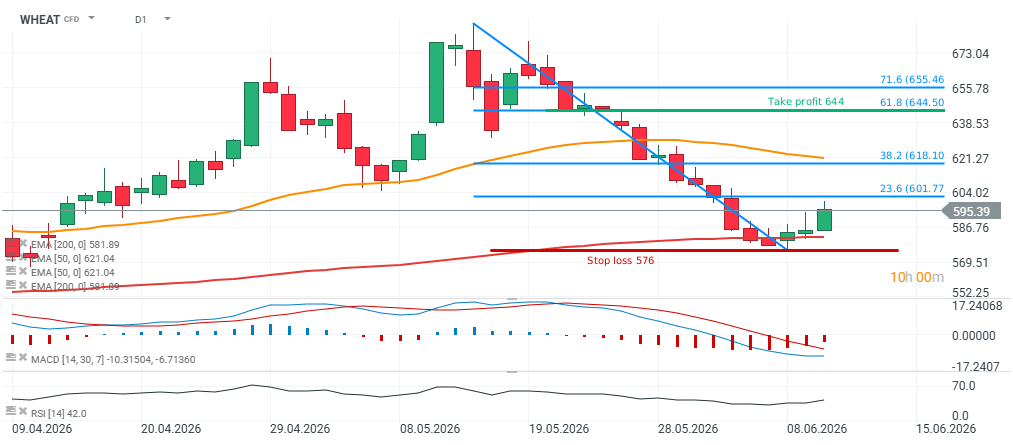
Source: xStation5
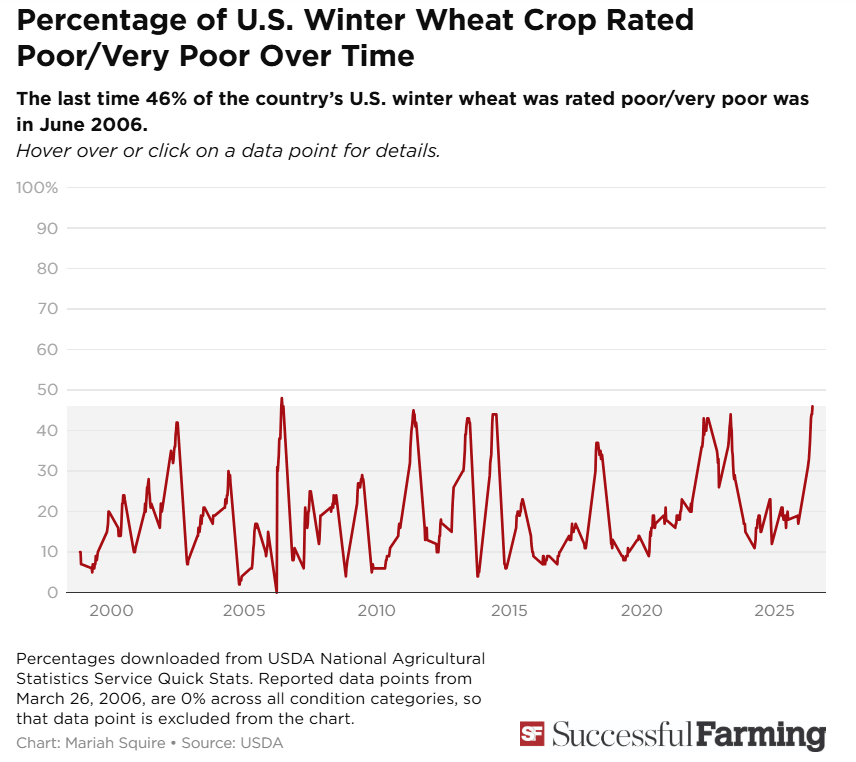
Sources: USDA, Mariah Squire, Successful Farming
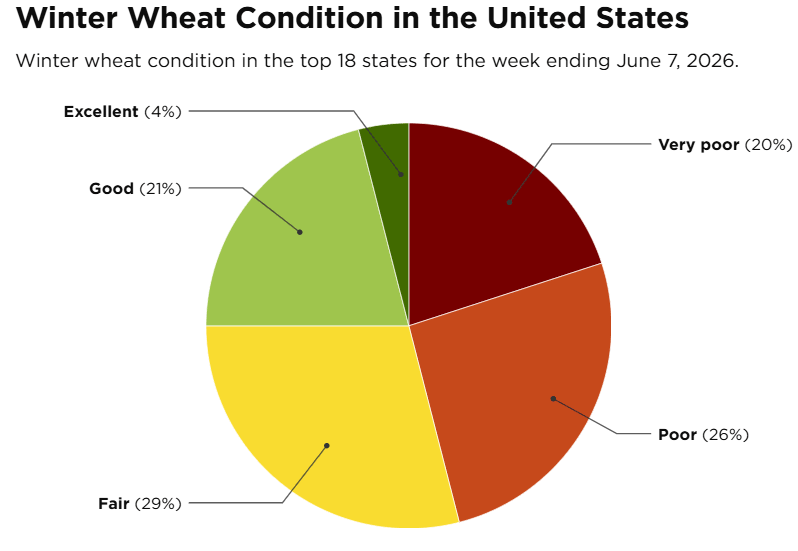
Sources: USDA, Mariah Squire, Successful Farming
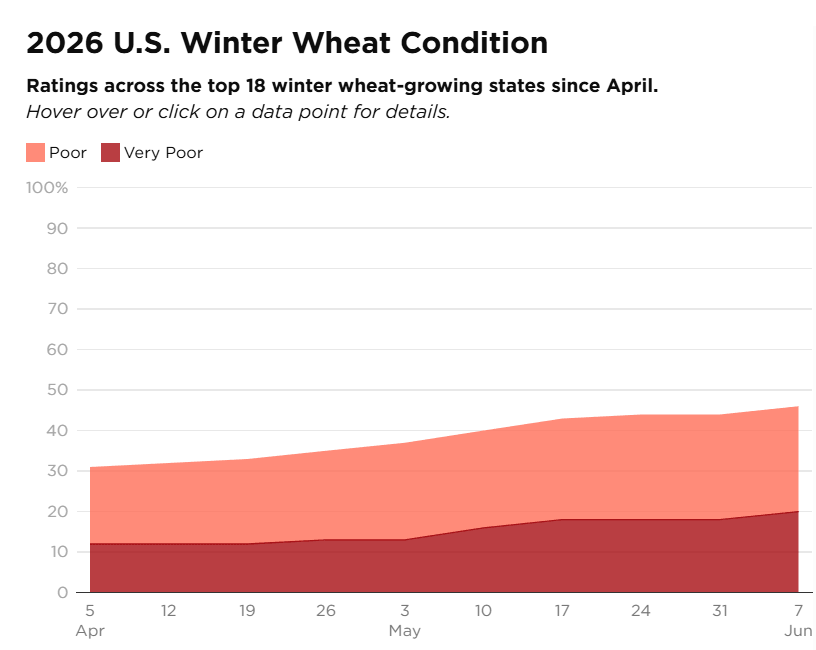
Sources: USDA, Mariah Squire, Successful Farming