S&P 500 — US Large Cap Index
 FTSE 100 — UK Blue Chips
 Euro Stoxx 50 — Eurozone Leaders
 DAX 40 — German Equities
 CAC 40 — French Market Index
 Nikkei 225 — Japan Benchmark
 Hang Seng — Hong Kong Index
 Shanghai Composite — China Mainland
 ASX 200 — Australian Market
 TSX Composite — Canada Index
 Nifty 50 — India Large Cap
 STI Index — Singapore Market
 KOSPI — South Korea Index
 Bovespa — Brazil Equities
 JSE Top 40 — South Africa Index
 IPC Index — Mexico Market
Huge SK Hynix sell-off. Has the AI bubble just burst? A bargain or a return to reality?

The rise in stock prices on the exchanges, driven by artificial intelligence, resembled an uncompromising, hands-off ride on the world’s fastest rollercoaster. Investors watched with delight as the valuations of tech giants climbed, believing there were no limits to the demand for advanced hardware. However, a single stronger gust was enough for market sentiment to collide with brutal reality. The South Korean Kospi index fell by as much as 8.3% at a critical moment, and the sharp SK Hynix sell-off reached 14%, triggering deep panic across the entire advanced technology sector. What actually happened behind the scenes, and why did panic suddenly grip the markets? In this article, we will examine the key reasons for this slump and look at the company’s fundamentals.
Main reasons for the slump and the SK Hynix sell-off
Reviewing various media reports, we can identify several factors that contributed to the sell-off of the Korean giant and other memory production companies:
- The “Excess Computing Power” Syndrome at Meta Platforms: Meta plans to launch a cloud infrastructure business that will sell access to AI computing power and models. This raised serious concerns about oversupply and overinvestment in the artificial intelligence sector. Experts suggest that the giant may have difficulty optimally utilizing its own resources, which carries negative consequences for component suppliers from Korea and Japan.
- The Chinese Shadow over Apple: The Cupertino corporation is negotiating the purchase of chips from two Chinese manufacturers: ChangXin Memory Technologies Inc. and Yangtze Memory Technologies Co. This information sparked fears that the technological lead of Samsung and SK Hynix is starting to dwindle dangerously. It may also exert strong pressure on the prices of standard DRAM memory, stripping Korean companies of their previous ability to dictate market conditions.
- Weak session on Wall Street and a ricochet from the USA: Today’s weakness in the Asian market was directly initiated by the dire sentiment in the USA from the previous day. The more than six-percent slump in the Philadelphia Semiconductor Index defined the negative sentiment at the opening of Asian markets from the outset.
- Clearing leveraged positions and retail panic: Sharp price movements exposed the presence in the market of leveraged ETFs, which drastically amplify price fluctuations in both directions. It is worth mentioning that dozens of leveraged ETFs on individual chip companies have been created in recent months (which obviously clashes with the idea of passive investing based on diversification). The sell-off is largely the effect of forced “flushing,” which is the mass closing of speculative positions by retail investors. While foreign capital fled, selling shares worth over 5 trillion won, individual investors tried to buy the securities.
Domino Effect: How does the SK Hynix situation affect other memory producers?
The technology market is a system of interconnected vessels. The crash in South Korea quickly infected the remaining exchanges, hitting global memory producers by ricochet. The scale of destruction in investors’ portfolios perfectly illustrates how fragile this “artificial” boom has become. Here is how badly key players worldwide suffered:
- Samsung Electronics lost as much as 10% amid the risk of losing its previous pricing power
- Kioxa Holdings Corp from Japan lost approx. 13% amid fears of an oversupply of computing power
- Micron Technology and SanDisk both lost 10% yesterday amid a broad sell-off of semiconductor companies.
This situation affects the entire industry in two ways. Firstly, the potential entry of Chinese entities into Apple’s supply chain exerts enormous pressure on the prices of standard commodity DRAM chips. Until now, Korean corporations have dictated the rules of the game here and imposed high margins. Secondly, the market gained painful proof of its excessive and risky dependence on just two companies. As Hugh Lam, an investment strategist at Betashares, notes, Asian technology stocks will now be extremely sensitive to any skepticism surrounding the profitability of investing in artificial intelligence.
Is it time for panic, or a cool correction?
Looking at the situation from a distance, we are not yet dealing with the ultimate bursting of the bubble and the end of the artificial intelligence era, but rather with a brutal process of verifying market enthusiasm. It is worth noting, however, that despite concerns about the durability of the artificial intelligence race, we are not observing slowdowns in orders and the construction of infrastructure needed for further development. Currently, we may be facing a slight rearrangement of the situation or a regrouping, which was already visible, for example, in the stock quotes of Nvidia or AMD in previous years.
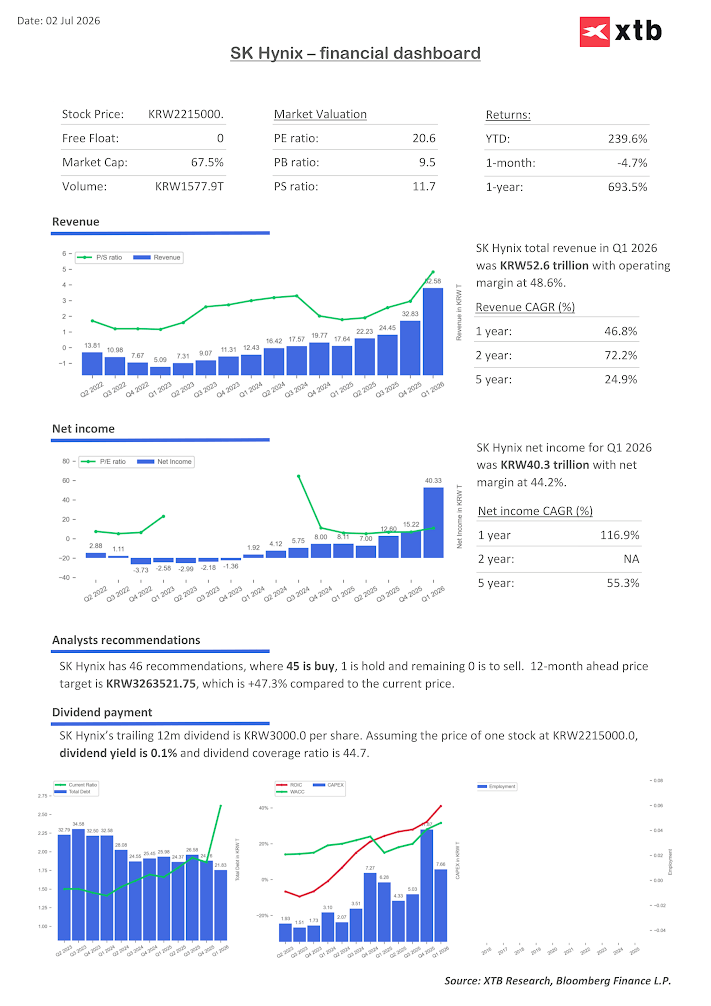
The current slump is a necessary cold shower that forces the investor to analyze what the companies themselves are showing. In the case of SK Hynix, we are still basing on the future, although the present already shows very solid data. The company generated almost 200% revenue growth for Q1 2026. The company’s profits are growing at a spectacular rate, although losses were still reported in 2023. Equally important, we are observing a very strong increase in the ROIC ratio above WACC, which constitutes real value building for the investor.
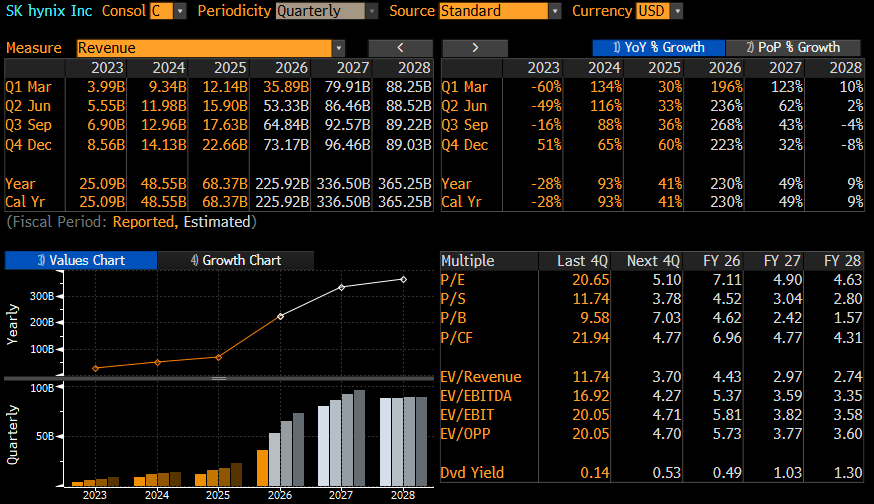
The forecasts for the company are spectacular and it is worth remembering that even if they are overly optimistic, they will largely be realized due to past orders. The company is expected to show over 200% revenue growth in the following quarters, which, given the current high margins, indicates that the Forward P/E ratio is expected to fall to a level of just 5, from the current 20. This is a very low valuation for the company. Looking at other indicators, such as P/S or even EV/EBITDA, the company is valued very conservatively. If it turns out that competition in China will only be a motivator for further development, it may seem that the company might look quite attractive after the recent correction. Source: Bloomberg
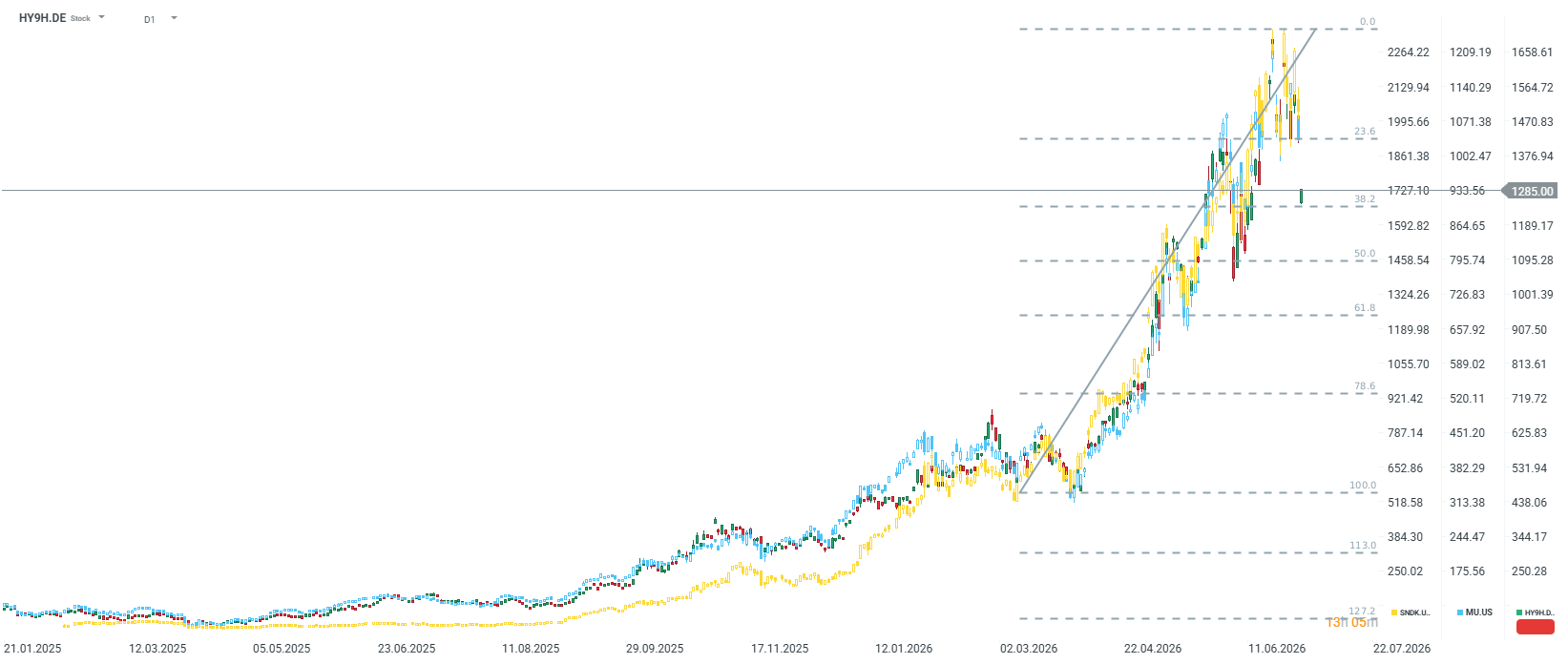
The company is available in Europe via GDR. Today’s decline has already been partially neutralized. Since April 1st, the company has increased in value by approx. 170%. Source: xStation5