S&P 500 — US Large Cap Index
 FTSE 100 — UK Blue Chips
 Euro Stoxx 50 — Eurozone Leaders
 DAX 40 — German Equities
 CAC 40 — French Market Index
 Nikkei 225 — Japan Benchmark
 Hang Seng — Hong Kong Index
 Shanghai Composite — China Mainland
 ASX 200 — Australian Market
 TSX Composite — Canada Index
 Nifty 50 — India Large Cap
 STI Index — Singapore Market
 KOSPI — South Korea Index
 Bovespa — Brazil Equities
 JSE Top 40 — South Africa Index
 IPC Index — Mexico Market
Stocks gain extends as AI momentum builds – Japanese Yen hits 1986 low


Asian equity markets finished the quarter with strong gains, supported by improving sentiment on Wall Street, where semiconductor stocks once again led the advance. The MSCI Asia Pacific Index climbed nearly 1.5%, capping its strongest quarterly performance in almost 17 years. Optimism also spread to futures markets, pointing to further gains in both U.S. equities—after the Dow Jones Industrial Average closed at another record high on Monday—and European stocks.
Key highlights
- South Korea remained the world’s best-performing major equity market this year, with the Kospi Index rising 2.9% during the session.
- AI-related semiconductor stocks continued to dominate the rally. Samsung gained more than 5%, lifting its year-to-date return above 100%, while SK Hynix finished the quarter with an extraordinary gain of nearly 240%.
- Currency markets focused on the Japanese yen, which weakened beyond 162 against the U.S. dollar, reaching its weakest level since 1986 and falling below levels that previously triggered official intervention in 2024.
- A weaker yen continues to support Japanese exporters and helps keep domestic equities near record highs, but it also raises import costs, weighs on household purchasing power, and increases political pressure on the government.
- Verbal intervention from Japanese officials, including Chief Cabinet Secretary Yoshimasa Kihara and Minister Katayama, failed to halt the currency’s decline.
- Brent crude traded near $72.50 per barrel and remains on track for its largest quarterly decline since the pandemic. The market continues to react to higher oil flows through the Strait of Hormuz following progress in regional peace negotiations.
- Morgan Stanley added to the bearish outlook for crude, warning that the global oil market could face oversupply in the coming months.
USDJPY Technical Outlook (D1, W1)
For several years, markets have anticipated a shift away from the Bank of Japan’s ultra-dovish monetary policy. While the BoJ has implemented modest rate hikes, its overall stance remains highly accommodative. The central bank still shows little determination to meaningfully reduce bond purchases or aggressively tighten policy despite weakening economic conditions. A weaker yen continues to support Japan’s export-driven economy and provides an important tailwind for the country’s largest listed companies.
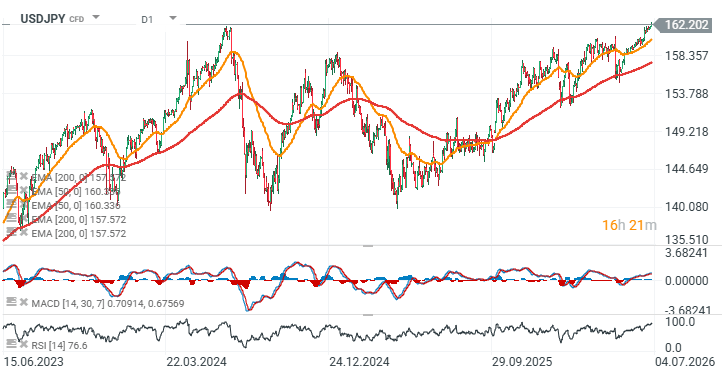
Source: xStation5
Although USD/JPY is trading close to multi-decade highs, the weekly RSI remains around 65, suggesting there is still room for further upside before technical conditions become overbought. In 2025, the pair successfully held support around the 200-week EMA near 147.5 before resuming its long-term uptrend. A decisive breakout above 163 could pave the way for another strong bullish impulse.
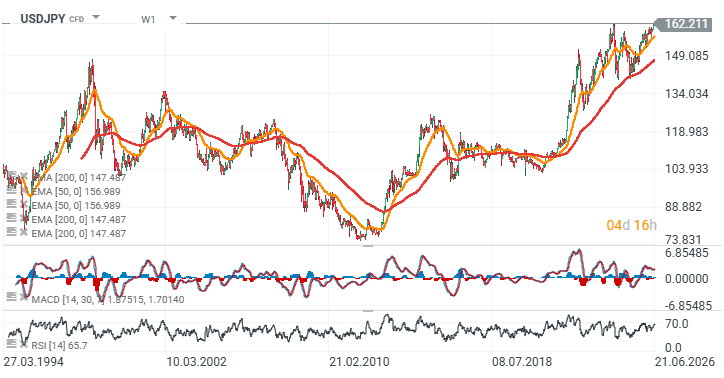
Source: xStation5