S&P 500 — US Large Cap Index
 FTSE 100 — UK Blue Chips
 Euro Stoxx 50 — Eurozone Leaders
 DAX 40 — German Equities
 CAC 40 — French Market Index
 Nikkei 225 — Japan Benchmark
 Hang Seng — Hong Kong Index
 Shanghai Composite — China Mainland
 ASX 200 — Australian Market
 TSX Composite — Canada Index
 Nifty 50 — India Large Cap
 STI Index — Singapore Market
 KOSPI — South Korea Index
 Bovespa — Brazil Equities
 JSE Top 40 — South Africa Index
 IPC Index — Mexico Market
USD/JPY has broken through a historic barrier — the yen is at its weakest since 1986


The Japanese yen reached 162.27 JPY per dollar, its lowest level in more than four decades. The USD/JPY pair thus broke through the all-time highs set in 1986, while also surpassing the levels at which Japanese authorities carried out costly currency interventions as recently as 2024.
The Weak Yen — Two Sides of the Coin
Currency depreciation is a double-edged sword for the Japanese economy. On the one hand, it boosts exporters’ performance and helps keep stock market indices near record highs. On the other hand, it dramatically drives up the cost of energy and food imports, erodes households’ real purchasing power, and exerts increasing political pressure on the government.
Verbal interventions had no effect
The Japanese establishment is stepping up its verbal warnings. Yoshimasa Kihara, head of the Cabinet Secretariat, has repeatedly expressed a “strong sense of urgency” regarding unilateral moves in the foreign exchange market. Finance Minister Satsuki Katayama has signaled a readiness to take “decisive action” and cited an agreement with the U.S. that explicitly allows for intervention. Despite these statements, the yen continues to lose value—the impact of the verbal warnings evaporates within just a few hours.
The money market sets the direction
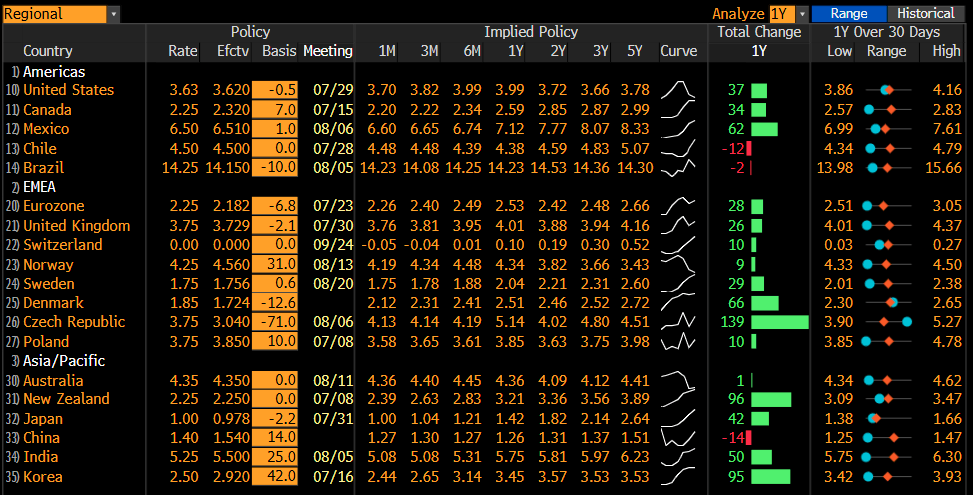
The key driver behind the yen’s weakness is the interest rate differential between the U.S. and Japan. The money market is pricing in an increasingly slower pace of rate hikes by the BoJ—the Bank of Japan raised its rate to 1.0% in June, but the next hike is not expected until October–December 2026. At the same time, sentiment surrounding the Fed remains hawkish, with expectations that rates will be kept at elevated levels or raised—which naturally supports further upward trends in USD/JPY. Source: Bloomberg Financial Lp
What’s next—a correction or a continuation of the trend?
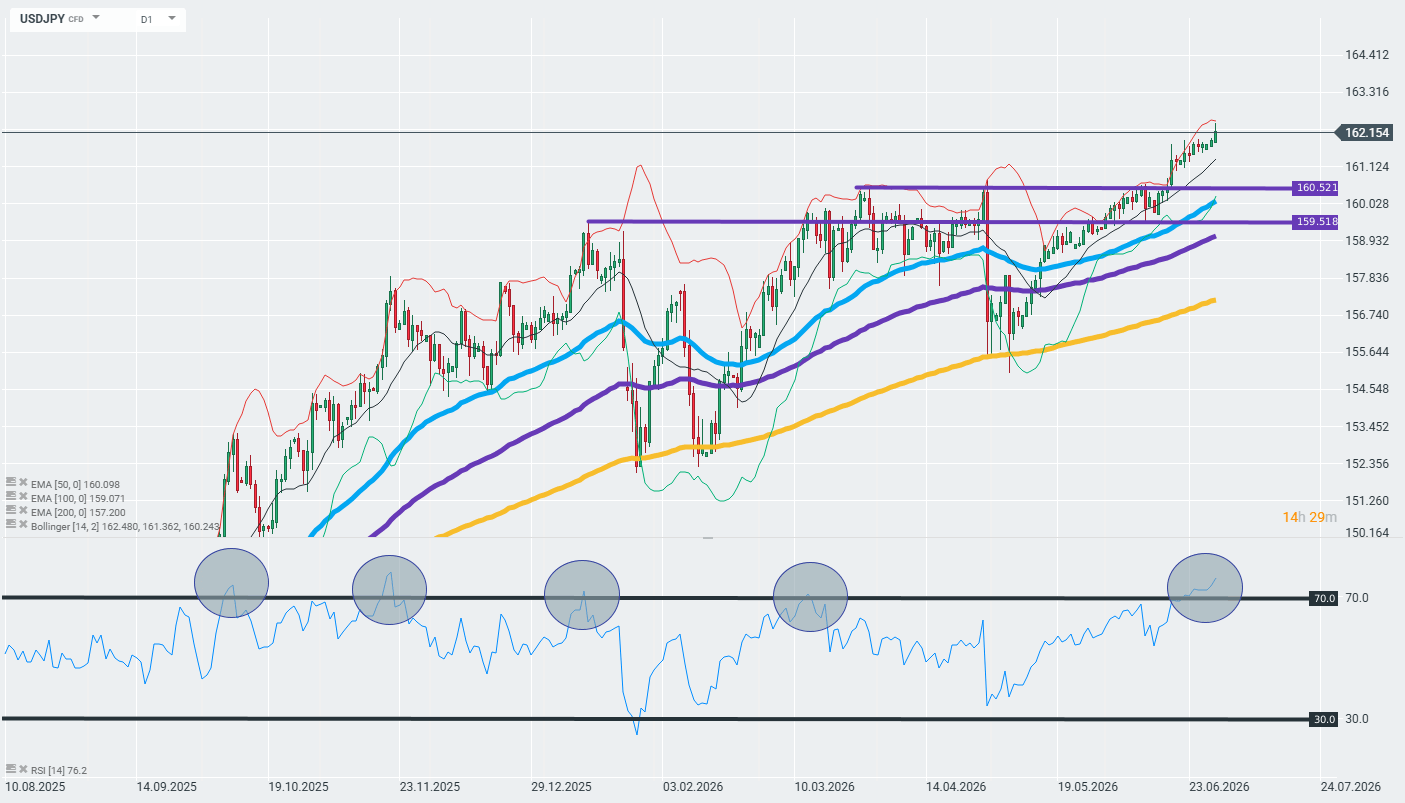
The technical picture for the pair is clear: the price has broken through key resistance levels at 160.52 and 159.52 JPY, both of which were marked on the chart and broken with momentum. The RSI (76.2) signals overbought conditions on the daily chart, which historically has preceded short-term corrections or consolidations—especially after approaching multi-year highs. The real risk, however, lies with intervention.
During the record-breaking April–May 2026 period, Japan spent as much as 11.73 trillion JPY to defend its currency, temporarily pushing the exchange rate down to ~155, but most of those gains have already been erased. History shows that interventions can generate sharp movements of several percent within minutes—but they do not change the structural trend as long as the interest rate differential remains so pronounced. As long as the BoJ does not surprise the market with a more aggressive tightening cycle and the Fed does not signal a clear pivot, the USD/JPY pair has room to continue its upward trend. However, the 162–163 JPY range is a high-risk zone for direct intervention—exchange rates could swing sharply in either direction.