S&P 500 — US Large Cap Index
 FTSE 100 — UK Blue Chips
 Euro Stoxx 50 — Eurozone Leaders
 DAX 40 — German Equities
 CAC 40 — French Market Index
 Nikkei 225 — Japan Benchmark
 Hang Seng — Hong Kong Index
 Shanghai Composite — China Mainland
 ASX 200 — Australian Market
 TSX Composite — Canada Index
 Nifty 50 — India Large Cap
 STI Index — Singapore Market
 KOSPI — South Korea Index
 Bovespa — Brazil Equities
 JSE Top 40 — South Africa Index
 IPC Index — Mexico Market

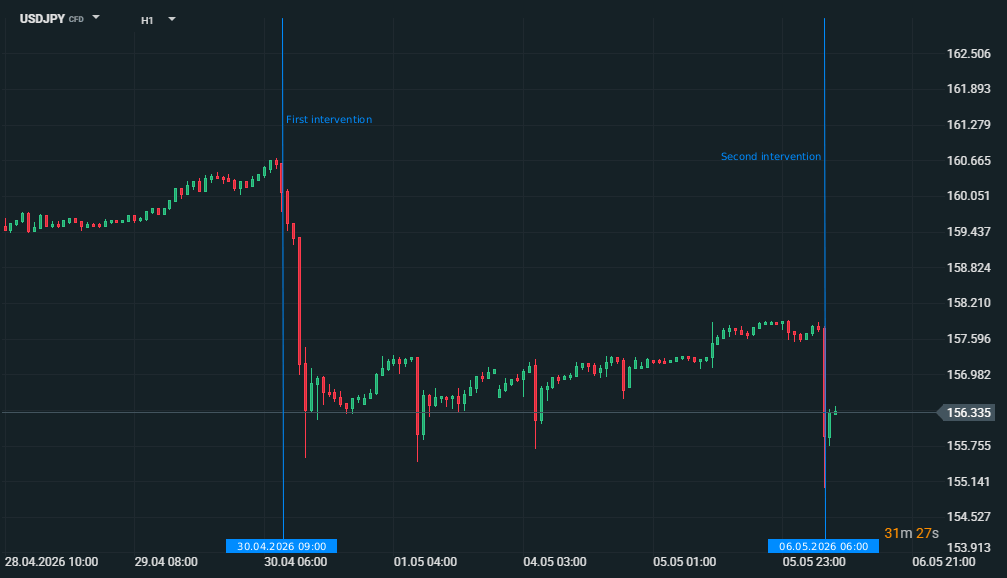
USDJPY was hit again today by a strong wave of yen buying, with the pair falling from the upper 157.700 area to 155.030. The move is being interpreted as another intervention by Japanese authorities. The timing fits the recent pattern: low liquidity around Japanese holidays and the transition from the Asian to the European session, when official flows can have a greater market impact. At the peak of the move, the yen strengthened by nearly 2%, toward the 155 area — the strongest level since February 24, 2026 — after Finance Minister Satsuki Katayama warned against speculative movements in the FX market.
This is another such intervention following last week’s large-scale operation. At that time, Bank of Japan money market data suggested that Tokyo may have spent around 5.48 trillion yen, or roughly 35 billion USD, to support the yen after USDJPY broke above the 160 level. The key signal for investors is that Japan’s Ministry of Finance is no longer limited to verbal warnings, but is actively attempting to cap USDJPY gains, particularly in the 158–160 zone. At the same time, rapid rebounds following earlier interventions show that these actions are buying time rather than changing the broader trend itself. Levels above 160 were also a critical point during the July 2024 intervention.
The fundamental backdrop remains difficult for the yen: the wide interest rate differential between the US and Japan, Japan’s dependence on energy imports, and geopolitical pressure related to the Strait of Hormuz continue to support the dollar and weaken the yen. The recent improvement in sentiment surrounding a potential US–Iran agreement has helped Tokyo through lower oil prices and a weaker USD, but if this pressure does not continue to ease — or if the Bank of Japan does not adopt a more hawkish stance — investors may continue to support the current weakening trend in JPY.