S&P 500 — US Large Cap Index
 FTSE 100 — UK Blue Chips
 Euro Stoxx 50 — Eurozone Leaders
 DAX 40 — German Equities
 CAC 40 — French Market Index
 Nikkei 225 — Japan Benchmark
 Hang Seng — Hong Kong Index
 Shanghai Composite — China Mainland
 ASX 200 — Australian Market
 TSX Composite — Canada Index
 Nifty 50 — India Large Cap
 STI Index — Singapore Market
 KOSPI — South Korea Index
 Bovespa — Brazil Equities
 JSE Top 40 — South Africa Index
 IPC Index — Mexico Market

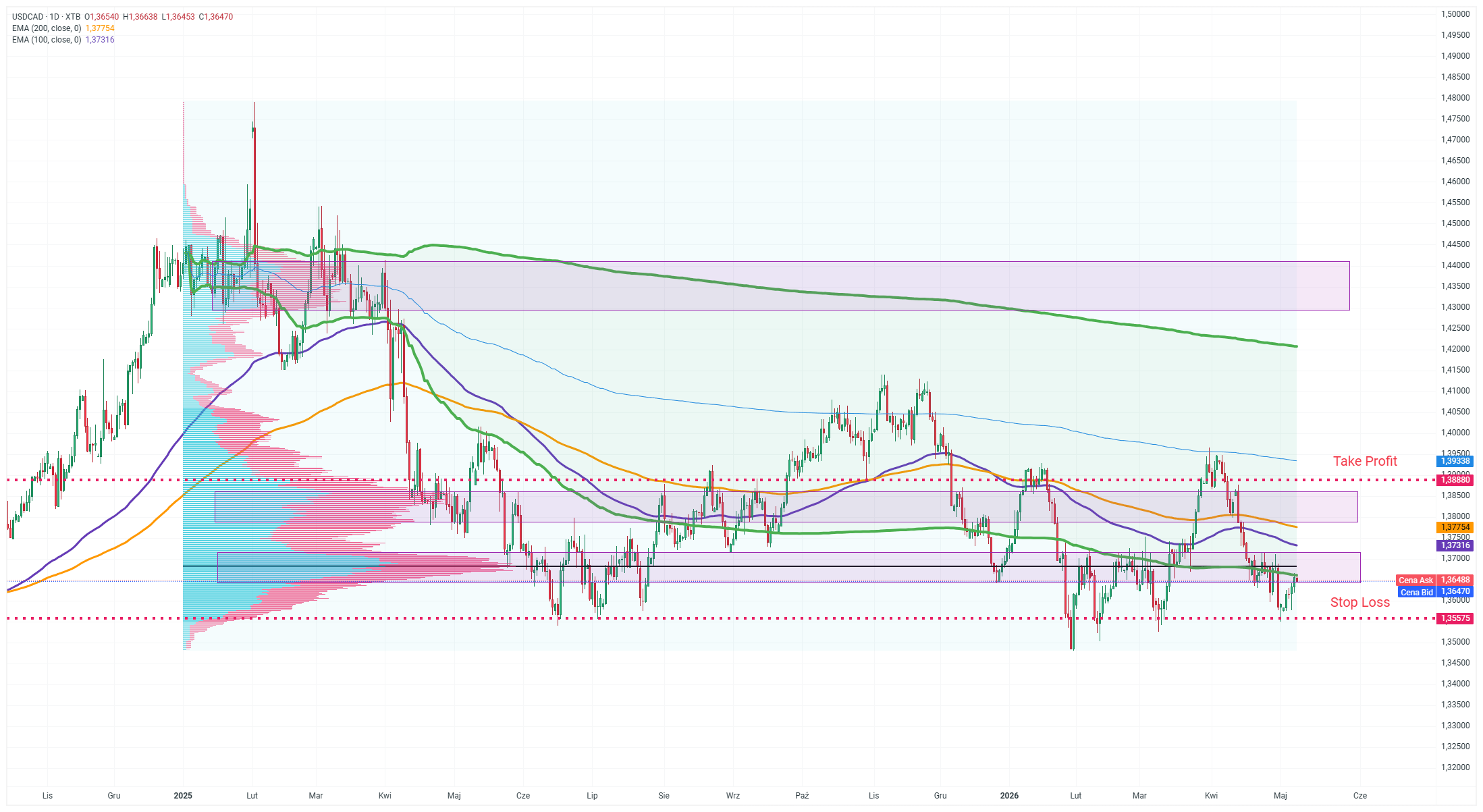
- The pair is testing the +1 standard deviation line of the anchored VWAP, calculated from 2 January 2025
- Canada is one of the world’s leading oil exporters
Recommendation:
- Long position on USDCAD at market price
- SL: 1.35575
- Target Price: 1.38880
Opinion:
The USD/CAD pair is currently trading around 1.3647, within a support zone defined by key volume patterns from the volume profile built since the start of 2025. Both the Stop Loss (1.35575) and Take Profit (1.38880) levels have been set in relation to the largest volume clusters visible on the profile – zones of historically high market activity which act as strong technical barriers. The price is approaching the lower boundary of a multi-month consolidation phase, and the 1.3620–1.3660 zone has repeatedly acted as a support level triggering upward movements, which confirms the validity of opening a technical long position.
The key fundamental argument is the CAD’s dependence on oil prices – Canada is one of the leading exporters of crude oil, and the Canadian dollar functions de facto as a petrodollar, meaning that any further falls in oil prices directly weaken the CAD and support an increase in USD/CAD. Given the growing oversupply in the oil market and the expected increase in production by OPEC countries, the risk of continued pressure on oil prices remains real, which further favours the long side on this pair, following a fairly significant depreciation over the long term.
Although the money markets are pricing in a more hawkish shift in the Bank of Canada’s stance in the future compared to the current one, the spread in short-term yields between the US and Canada (1M: 3.64 vs. 2.25) still points to a carry trade in favour of the USD. However, we recommend exercising particular caution, as the fundamental environment for this pair may change rapidly and thus undermine the current basis for this recommendation.
Source: xStation
Methodology and assumptions:
The recommendation is based on a technical and fundamental analysis of the USD/CAD chart. Classical technical analysis was used to assess the situation and analyse the trend.